

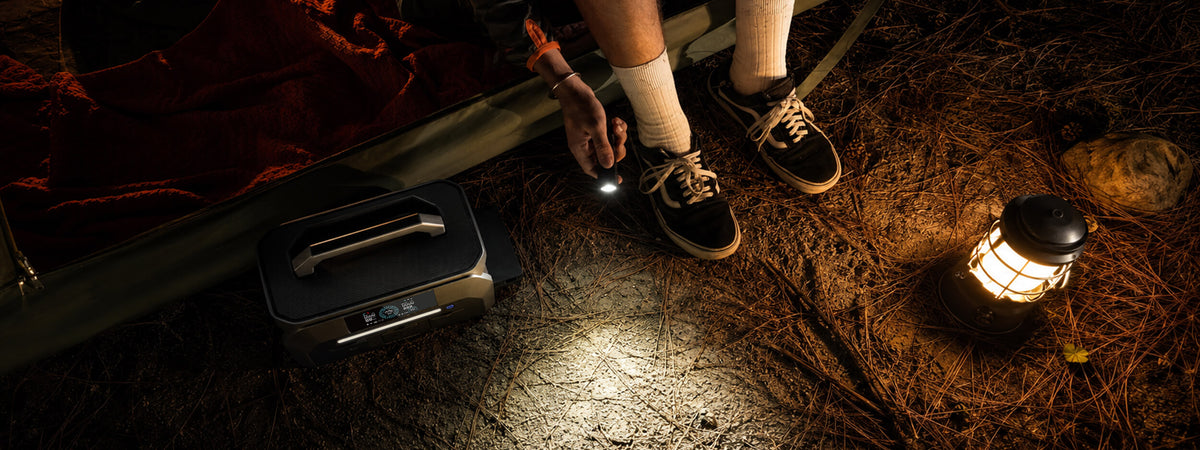
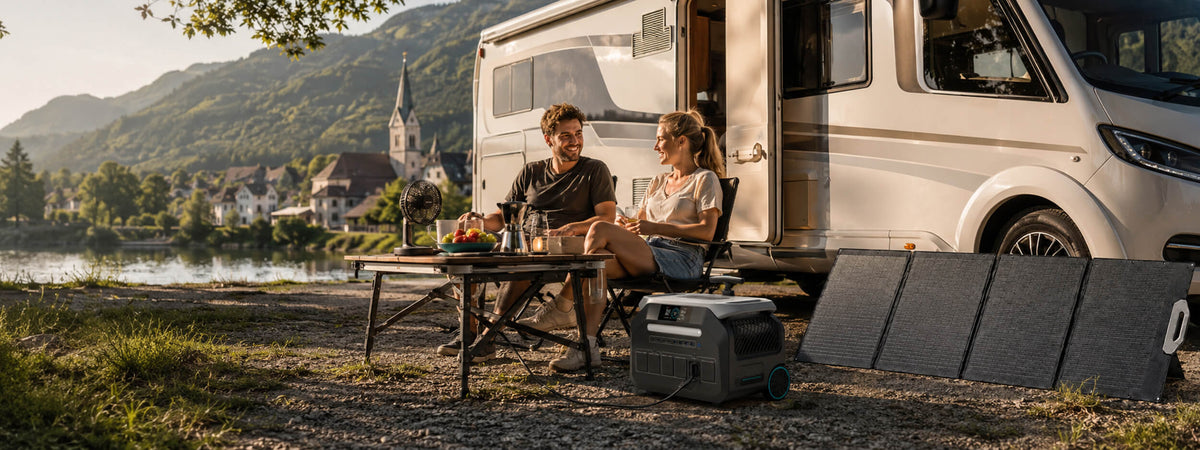
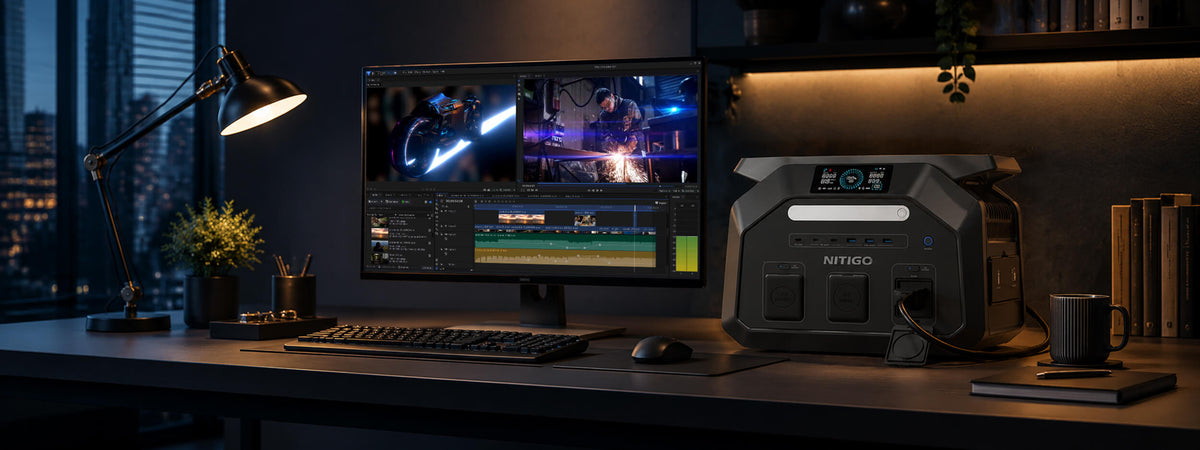
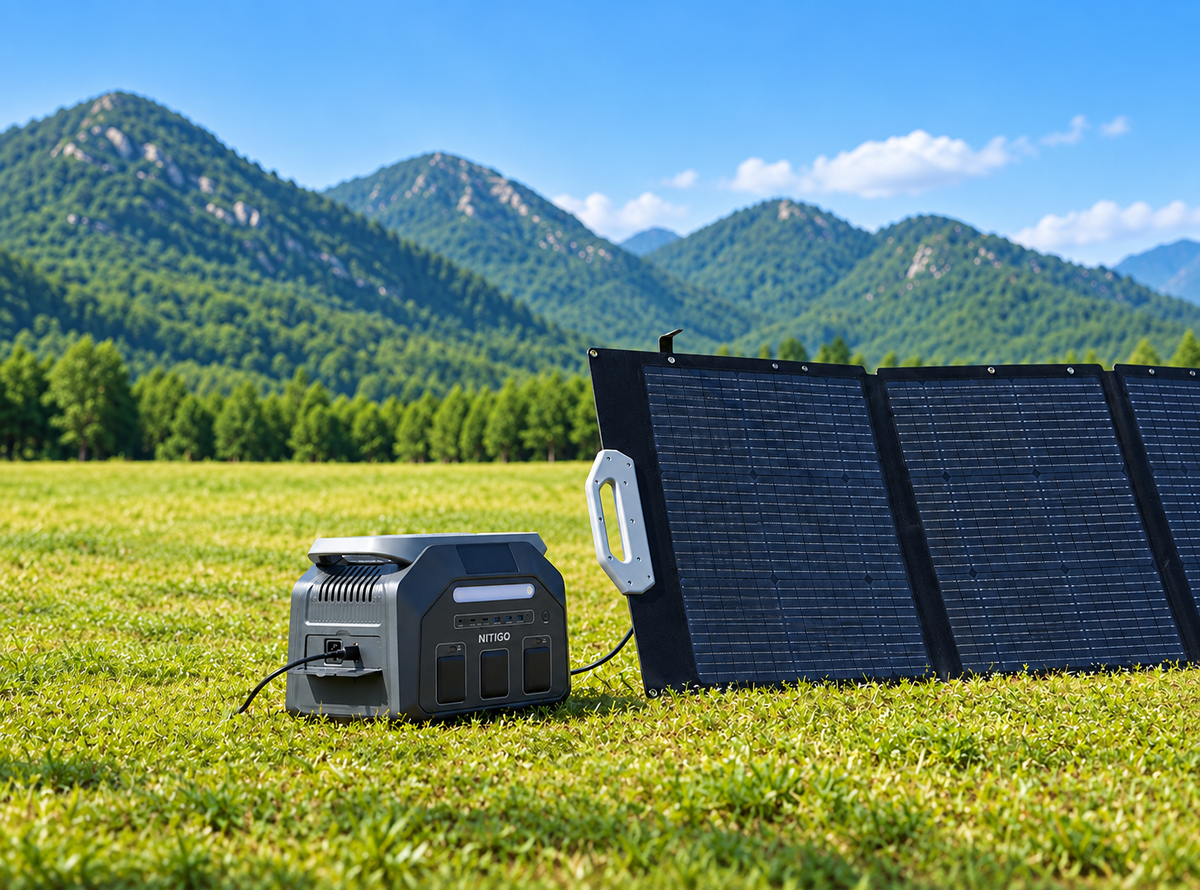
If you want to camp independently of the power grid for several days, you will quickly notice how many devices regularly require energy. The cool box runs in the morning, smartphones are charged during the day and lighting or laptops are added in the evening. To ensure that the power station does not run out of energy sooner than expected, a solar panel for camping should match your actual daily consumption, be electrically compatible and be easy to transport.
However, a high wattage alone does not guarantee sufficient power supply. Sunlight, shading, temperature and orientation determine how much energy the panel actually produces. Weight, folding size and available floor space also play an important role in the selection. Below you will learn how to first calculate your daily electricity requirements and then derive the appropriate panel power, the expected charging time and the suitable design.
What is your daily electricity requirement when camping?
For each device, add the power in watts multiplied with the daily usage time in hours. The result in watt hours shows approximately how much energy you need per day. Separately, calculate the highest power that occurs at the same time, because this determines whether the power station can even supply the connected devices.
Record the consumption of cool boxes, lights, smartphones and laptops
The most reliable information is the information on the nameplate, the power supply or in the operating instructions. For devices whose consumption fluctuates, an energy cost meter connected to the mains connection provides a more realistic value than the nominal output. For example, in a compressor cooler, the compressor does not run continuously, but ambient temperature and frequent opening have a significant impact on daily consumption.
A simple camping bill could look like this. The values only serve as a calculation example and must be replaced by your actual device data.

Calculate daily consumption and short-term performance peaks separately
Watt-hours describe the amount of energy, while watts describe the instantaneous power. A power station can have enough capacity for the day and still switch off if a device briefly requires more power than its output allows when starting up. Compressors, pumps and some kitchen appliances are typical candidates for such spikes.
For the selection, keep two separate key figures:
- Daily requirement in Wh: Add up the energy of all devices over a whole day.
- Simultaneous power in W: Add up all consumers running in parallel and also check the starting or peak power for motors.
How much power should a solar panel provide for camping?
The panel output should be able to recharge the daily requirement during the usable hours of sunshine and a weather reserve included. To make the selection, divide the daily requirement by the expected productive hours of sunshine and then take losses into account. A rigid wattage recommendation for every trip would be misleading.
Adjust panel output to power consumption and travel duration
With a daily requirement of 550 Wh and assuming four productive hours of sunshine, 137.5 W would be necessary. Since a panel in camp rarely achieves its rated output permanently, a 200W panel in this example more plausible than a 140W panel. However, in a cloudy location or in the shade, even the larger panel cannot meet the needs.
For a weekend with a full battery, the daily yield may be slightly less than consumption. On longer, self-sufficient trips, the energy balance must be balanced on average.
Differentiate between nominal output and realistic daily yield
The nominal power is determined under specified test conditions. In everyday life, irradiation, cell temperature and angle of incidence change continuously. This EU PVGIS tool shows how much solar radiation and possible PV yield depend on location, month and orientation. For a mobile structure, it makes sense to consider several scenarios instead of a single ideal value.
Diffuse radiation also contributes to yield. The German Weather Service explains global radiation as the sum of direct and diffuse solar radiation. An overcast sky does not necessarily mean zero performance, but the yield can decrease significantly. Monitor the input power on the power station and adjust the position of the panel throughout the day.
How can the expected loading time be calculated?
Divide the energy to be recharged in Wh by the actual solar power in W. At 600 Wh and an average of 120 W, the ideal calculation results in five hours; Fluctuations and self-consumption prolong them.
When estimating, proceed in this order:
- Determine the missing battery charge in Wh, do not automatically use the entire capacity.
- Estimate realistic solar power at the input and deduct current consumers.
- Divide missing energy by the remaining input power and plan a reserve for fluctuations.
Consider battery capacity and solar input power
Calculate the missing energy, not automatically the entire battery capacity. A 1,000 Wh battery at 40 percent charge still requires around 600 Wh to reach full capacity. If the solar input of the power station is limited to 100 W, under ideal conditions a 200 W panel will still only deliver at most the power accepted by the input.
If devices are running while charging, subtract their usage from the solar output. If 150 W arrives from the panel and the cool box consumes just 45 W, that leaves around 105 W for the battery. This calculation explains why the remaining time display can jump during changing cloud cover.
Plan for losses due to weather, temperature and shading
Expect a sunny and an unfavorable scenario. With 200 W nominal power, four productive hours and an assumed total factor of 0.6, this results in around 480 Wh daily yield. The factor is not a product characteristic, but rather represents orientation, temperature, cabling and charging losses in a simplified manner.
Shading deserves special attention because even one strip of shadow can severely impact a panel's performance. The consumer advice center for PV alignment cites an area with as little shade as possible as well as alignment and radiation as essential conditions. When camping, the panel is easier to move than a roof system, so take advantage of this.

Which design and weight suit your trip?
Choose the design based on transport route, storage space and installation routine. A larger mobile solar panel can provide more energy, but takes up more space and is more complex if you change location frequently. Different compromises make sense for cars and motorhomes than for backpacks or bicycles.
Compare folding dimensions, weight and available storage space
Before choosing, check three practical points:
- Folding size: Does the closed panel fit in the intended storage space?
- Installation dimensions: Is there enough free, sunny space at the campsite?
- Total weight: Are the bag, cables and adapters included in the weight?
When backpacking, it's the ratio of performance to total weight that counts. The panel can be heavier in the vehicle, but should be able to be carried by the person who sets it up every day.
Consider transport route, assembly frequency and floor space
If you change location every day, a few folding segments and quickly adjustable supports are practical. Check whether the unfolded module is secure between the vehicle, awning and neighboring plot. Mobile panels offer flexible alignment and require wind, theft and tripping protection.
How is a mobile solar panel set up correctly?
Place the panel free of shadows, as directly as possible to the sun and stable. Check the input power after setup and again later because trees, vehicles and the sun change the shape of the shadow. A small change in position can bring more than additional nominal power.
Regularly check the alignment, tilt angle and shadows
Align the module surface as vertically as possible to the sun's rays. A generally fixed angle does not fit every time, season and region. It is practical to check on the display: change the angle and direction slightly and maintain the position with the higher, stable input power.
Check the position several times a day because moving shadows can later obscure cells. Only clean the surface according to the product instructions.
Check the feet, base, wind protection and cable routing
Place all feet on a stable surface and secure the panel against wind according to the instructions. In a storm it should be folded up in good time; Weights on the cell surface can cause damage.
Lay cables so that no one trips over them and plug connections remain dry, clean and strain-relieved. The DGUV instructions for mobile electrical devices make it clear that electrical equipment must be selected to suit the operating conditions. In addition, always follow the instructions for the panel and power station.
Is the camping solar panel compatible with your power station?

A panel is only compatible if the voltage, current, power, connection and polarity are within the specifications of the solar input. A suitable plug alone is not enough.
The technical test follows a clear sequence:
- Compare the maximum open circuit voltage of the panel with the permissible input voltage.
- Compare the panel current and nominal power with the input limits of the power station.
- Check plug type, adapter assignment and polarity.
- Only connect after complete adjustment and observe the input power.
Adjust the open circuit voltage, current and solar input
The panel's open-circuit voltage, often called Voc, must not exceed the maximum input voltage of the power station. The input current and solar power must also match. Since Voc can increase in cold weather, the manufacturer's temperature information is relevant.
With two panels, the interconnection changes the electrical values. The voltages add up in series and the currents add up in parallel. Only use a combination if the panel instructions and power station expressly allow it and all limit values are adhered to.
Check connections, adapters and polarity before use
Use undamaged cables with a suitable cross-section. Unsuitable adapters can prevent charging or damage devices.
You can find the permissible solar input values and connection information for NITIGO power stations in the current user manuals. If the model version or adapter is not clear, clarify the combination in advance via the NITIGO online support. This avoids mixing data from similar models.
Select the right NITIGO solar panel specifically
Make your selection in this order: first energy requirements, then electrical compatibility, then transport and assembly. The following overview summarizes the decision.
| Priority | Test question | Next step |
|---|---|---|
| 1. Need | How many Wh do you need per day? | Record devices and runtimes |
| 2. Performance | What real daily yield is necessary? | Plan for hours of sunshine and losses |
| 3. Compatibility | Do Voc, current, watts and plugs fit? | Compare both instructions |
| 4. Mobility | Are the weight, folding dimensions and footprint correct? | Practically play through the transport route |
For a power station solar solution for camping, no single data sheet value should determine the decision. Compile your consumption list and the technical input data and have any questions checked before purchasing. About the NITIGO contact You can classify a suitable solar panel according to power requirements, transport dimensions and compatible power station and at the same time confirm current availability.

Frequently asked questions
Q1 Can a camping solar panel be used behind a window pane?
Yes, Technically, depending on the panel and pane, it can generate electricity, but usually with a lower yield. Glass, coatings, awkward angles and heat reduce usable radiation, so a safe outdoor location is usually more suitable.
Q2 Can two mobile solar panels be connected together?
Yes, if the panel and power station expressly support the intended series or parallel connection. Depending on the circuit, add voltage or current and do not exceed any input limit.
Q3 Can a foldable solar panel be left outside when it rains?
Sometimes, depending on the declared protection class and the manufacturer's instructions. Even with a weatherproof panel, plugs, adapters or connection areas may have different boundaries and must not be in water.
Q4 Does a longer cable affect solar performance?
Yes, Because cable losses increase with length and current, especially if the cable cross-section is too small. Use the shortest possible, suitable cable within the manufacturer's approvals and avoid additional adapter chains.
Q5 Can the solar panel stay connected overnight?
Mostly, provided the operating instructions for the panel and power station allow this and the input is protected against reverse current. If the release is unclear, moisture is present or the plugs are damaged, disconnect the connection and ask support.