



After a camping trip or a power outage, the power station often sits unused in the storage room for several months. The next time it is used, it should work immediately and be able to be charged safely. It's not just the charging cycles that count: temperature, charging status and storage location also influence the power station's service life.
Care does not stop natural aging, but it can reduce unnecessary stress. What is crucial is a suitable storage charge level, a dry and moderately temperate location and an inspection before re-use. This guide shows you how to do this.
What does lifespan mean for a power station?
Lifespan can mean the operating time with one battery charge, the number of usable charging cycles or aging over the years. A lithium power station can only run for a few hours per charge and still remain usable for many years. Conversely, a large capacity does not guarantee slow aging.
| term | Meaning |
|---|---|
| Runtime per charge | How long the stored energy lasts for the connected devices |
| Cycle life | How many complete charging cycles the battery achieves until it reaches a defined remaining capacity |
| Calendar aging | Loss of capacity due to time, temperature and state of charge, even without frequent use |
| remaining capacity | The still usable portion of the original battery capacity |
Why is run time per charge not lifespan?
The runtime depends on battery capacity, device performance and conversion losses. The question “How long does a power station last?” therefore needs two answers: Watt hours and consumption count for the runtime, while cycles, aging and care count for the service life.
What does remaining capacity mean after a certain number of cycles?
A charging cycle corresponds to a total of 100 percent of energy extracted and recharged. Two discharges of 50 percent each can add up to approximately one cycle. With 80 percent remaining capacity, the battery still stores around four fifths of its original amount of energy; the runtime per charge is correspondingly shorter.
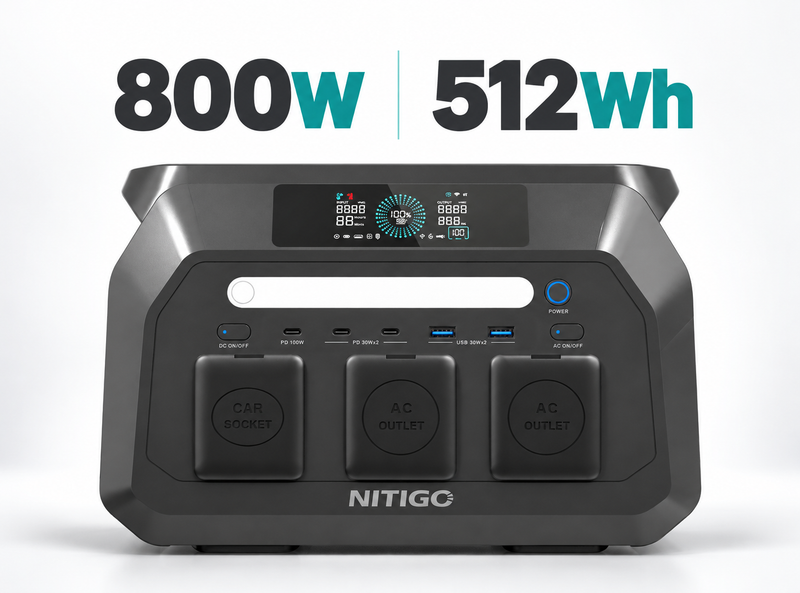
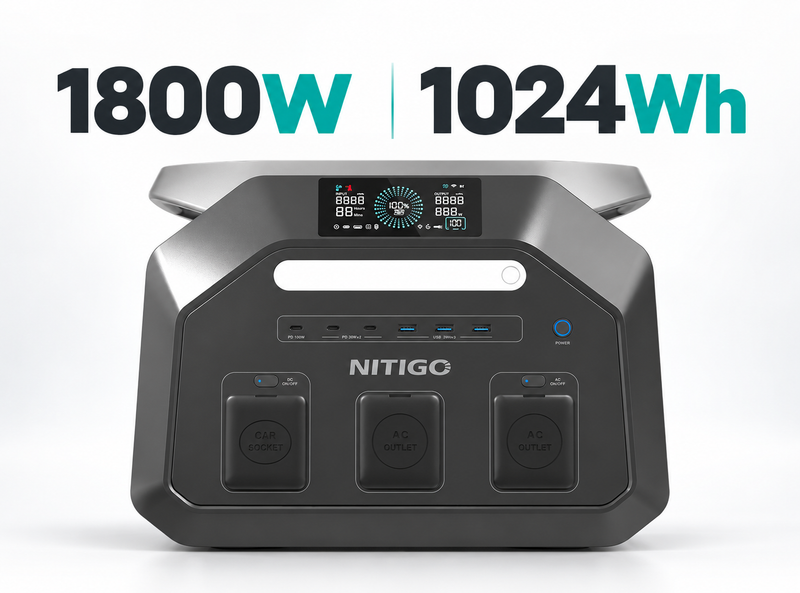
Our current P800, P1800, P2400 and P3200 use LiFePO4 batteries. On the product pages we mention more than 4,000 charging cycles and then around 80 percent remaining capacity. The information describes a test and orientation value, not a guarantee for a fixed number of years of use. You can find an overview in ours portable NITIGO power stations.
Which factors cause the battery to age faster?
Lithium-based batteries age during use and storage. Therefore, clear basic rules also apply to a lithium-ion power station: avoid extreme temperatures, do not store it fully charged for an unnecessarily long time and prevent deep discharge. NITIGO models use LiFePO4 cells, but remain temperature-sensitive energy storage devices.

Why is temperature particularly important?
Heat accelerates chemical aging and can increase safety risks. Severe cold temporarily reduces available power and can be problematic when charging. This Federal Environment Agency recommends storing lithium batteries at 10 to 25 degrees Celsius, a dry place and protection from direct sun. The specific operating and storage temperature range of the respective model in the manual always takes precedence.
After being transported out of extreme cold, the power station should adapt to the room temperature when it is switched off. so that no moisture condenses on electronics and connections. A hot vehicle, a damp basement or a place next to a heater are unsuitable.
What role does frequency of use play?
Frequent use causes the number of charging cycles to increase more quickly. Infrequent use does not automatically protect the battery because calendar aging and self-discharge continue. Charge as needed, avoid deep discharges and do not leave the device unattended for a long time in an extremely high or low charge state.
How is a power station properly charged and stored?
Use the designated cables and chargers. Ventilation openings must remain clear; Do not charge under textiles or next to easily combustible materials. Also protect the battery from shock, moisture and strong heat.
Should the battery be fully charged before storage?
Neither an empty nor a permanently fully charged battery is ideal for a longer storage break. The Federal Environment Agency cites lithium batteries for many around 40 to 50 percent as a suitable storage condition. Those too Consumer advice center advises against complete discharge. The storage instructions in the manual for your power station remain relevant, as the battery management and the manufacturer's specifications depend on the model.
Before storing, we recommend this short sequence:
- Disconnect all consumers and switch off the power station.
- Check the housing, connections and cables for damage or contamination.
- Establish the bearing charge level recommended by the manufacturer.
- Store the device dry, stable, frost-free and protected from direct sun.
- Note the storage date and charge status so that the next check is not forgotten.
How often should the charge level be checked?
There is no generally valid month number. Self-discharge, storage temperature and electronics differ depending on the model. Check the charging status at the interval specified in the operating instructions. If there is no fixed period of time, a recurring reminder can help: Check the display and device status regularly and recharge in good time before the battery is very discharged. Even a portable lithium power station should not be left unattended for years if it is used infrequently.
How is the power station checked after a long break?
After a long period of storage, the power station should not immediately run at high load. Check the device and observe the initial charging process. Never open the case yourself.
What damage must be ruled out before charging?
Before using for the first time, proceed in this order:
- Inspect the case for bloating, cracks, warping, and discoloration.
- Check sockets and cables for corrosion, loose parts, crushing and exposed conductors.
- Look for any unusual odors, leaks, or greasy deposits.
- If the device is cold or damp, leave it turned off and allow it to fully acclimatize and dry.
- Start the charging process with free ventilation and observe the display, temperature and noise development.
- Then first test a small, non-critical consumer before connecting higher loads.
When should operations stop immediately?
Switch off the device and only disconnect it from the power supply if it is safe to do so. Warning signs include strong or rapidly increasing heat, smoke, pungent smell, hissing, bloating, escaping substances and recurring error messages. The German statutory accident insurance lists deformation, discoloration, odor, heating and leakage as important abnormalities. Do not continue to use or ship a damaged device. Keep your distance and contact the manufacturer or a suitable collection point.
Which NITIGO power station and which service are right for you in the long term?
The model size depends on runtime and performance. Add up all devices operating at the same time and take possible start-up peaks into account.
| model | Capacity | Continuous performance | Typical classification |
|---|---|---|---|
| P800 | 512 Wh | 800W | Compact mobile applications and small consumers |
| P1800 | 1,024 Wh | 1,800W | More energy reserves and stronger individual devices |
| P2400 | 2,048 Wh | 2,400W | Longer operations and multiple consumers |
| P3200 | 2,048 Wh | 3,200W | Higher simultaneous output power |
Capacity and performance do not replace checking connections, input limits and permissible operating conditions. Therefore, compare the current product page with your device requirements before purchasing. The information for the respective model version applies to care, storage and commissioning.
You can find the relevant documents in ours Operating instructions. According to current information, this applies to power stations NITIGO warranty information a voluntary guarantee of 36 months. If you register within 30 days, it can be extended by two years for participating models. Normal loss of capacity due to aging, use and charging cycles is not automatically considered a defect. Before purchasing, check the current conditions and keep the proof of purchase.
Therefore, choose the power station based on performance, capacity and planned use. With proper storage, regular checks and appropriate service, you create good conditions for long and safe use.

Frequently asked questions
How long does a power station last on average?
A fixed average number would be misleading. The technical lifespan depends on cell chemistry, charging cycles, temperature, state of charge and calendar aging. Cycle information shows the remaining capacity up to which a battery has been tested under certain conditions. They cannot easily be converted into years.
Does constant charging damage the battery?
Battery management protects against classic overcharging, but long stays at a high charge level and additional heat can promote aging. Only leave the power station permanently connected if the manufacturer specifies this use for the specific model. Pay attention to ventilation, temperature and the instructions for through-charging or UPS operation.
How long can a power station remain unused?
There is no universal maximum duration for this. The recommended storage charge level, a suitable storage location and regular checks are crucial. If the charge level drops significantly, you should recharge according to the operating instructions before a deep discharge occurs.
Is a power station defective after reaching 80 percent remaining capacity?
No. 80 percent remaining capacity initially means that less energy can be stored than when it was new. The power station can still be used as long as it works safely and the remaining runtime is sufficient. Normal loss of capacity must be distinguished from a technical defect.
How is a used power station properly disposed of?
A power station with a lithium battery does not belong in household waste. Hand them in at a suitable municipal collection point or via a designated take-back system. Damaged, bloated, leaking, or overheated devices must not be shipped independently. Please clarify the safe handover with NITIGO Support or the local collection point beforehand.