




You don't choose a suitable power station based on as many watts as possible or a cheap offer alone. What matters is whether the output power, usable capacity, connections and charging methods match exactly the devices you want to operate and for how long. If you separate these variables and then combine them, you avoid two typical bad purchases: a station that cannot start the appliance or a battery that is empty earlier than expected.
It therefore makes sense to start with a device list instead of a model name. Performance, runtime and concurrency form the basis; This is followed by a realistic buffer and a check of mobility, solar option and UPS function. The following seven steps lead from your application profile to a reliable purchase decision.
Who is a power station suitable for?
A power station is suitable for people who temporarily operate individual electrical devices without a fixed socket or who want to specifically bridge a power failure. However, it neither automatically replaces a permanently installed backup power system nor does every model provide enough power for every household appliance.
Differentiate between household, camping and mobile working
The most important differences can be sorted by area of application:
- household: Router, lighting, cooling device or a workstation usually determine the need. The decisive factors are the runtime, 230-volt power and a suitable reserve.
- Camping: Weight, quiet operation, 12-volt outputs and solar charging are more prominent. A small power station can be enough for a camera, smartphone, laptop and light.
- Mobile working: Powerful USB-C, multiple charging slots and the runtime of laptops, monitors and network devices are often more important than very high peak performance.
-
Strong consumers: Coffee machine, kettle or power tool significantly increase the required output power. Rare additional requests belong in reserve rather than as the main need.

Set device list and desired runtime
A reliable device list is created in three consecutive steps:
- Record power consumption: Watt values are usually found on the nameplate, power supply or in the instructions. When consumption varies, an electricity meter provides better values than an estimate over a representative period of time.
- Set term: Each consumer has the desired period of use. This makes it clear whether a device only requires a few minutes or several hours of energy.
- Mark simultaneity: Laptop, router and lamp together can only require around 90 watts. With a 1,400-watt coffee machine running in parallel, the load briefly increases to around 1,490 watts.
This lays the foundation for calculating continuous power and power peaks separately in the next step.
How much power is really needed?
The necessary power is the sum of all devices operated at the same time, supplemented by reserves for start-up and load peaks. What is important is the continuous output of the inverter, not just a large print peak.
Continuous performance of all devices used at the same time
Three clear comparison cases help with continuous performance:
- Under 500 watts total load: A more compact power class may be sufficient for laptops, routers, lights and smaller electronics. Additional watts are of little use if the weight and price increase significantly.
- Between 500 and 1,500 watts: Several devices or individual, more powerful consumers require noticeable reserves. The total number of devices active at the same time remains decisive.
- Around 2,000 watts and more: A power station in the 2,000 W class becomes interesting when kitchen appliances or tools actually run in parallel. The mere possibility of a high load does not justify a larger model.
The ADAC test for mobile power stations explains the central key figures: Watt describes the permanently deliverable power, Watt hours describes the stored energy. The test results also show why data sheet values and usable energy should not be equated. Continuous performance, connection limits and capacity therefore belong in separate comparison columns.
Start-up and peak performance with reserve
For devices with a short-term high start-up requirement, three points count:
- Starting value: Motors and compressors, for example in refrigerators or pumps, can require significantly more power when starting than during operation.
- Power reserve: For normal electronics, around 20 percent above the calculated continuous load is a useful planning figure. Motor and heating devices require a model-related comparison.
- Surge limit: Peak power only applies to short peak loads. It must not be counted as permanently available output power.
As soon as this performance limit is determined, the capacity determines the achievable runtime.
Which capacity fits the planned term?
The capacity in watt hours determines how long the station can provide energy. First calculate the theoretical requirement and then increase it by losses and an operational reserve.
Calculate watt hours from consumption and usage time
The calculation follows a short order:
- Multiply performance by runtime: 80 watts × 5 hours results in 400 Wh for a laptop.
- Add more consumers: 12 watts × 10 hours results in 120 Wh for the router. Together, the theoretical requirement is 520 Wh.
- Apply changing loads realistically: For a refrigerator, the measured average consumption over a longer period of time counts. Coffee machines and kettles, on the other hand, require a lot of power but usually only run for a short time.
The calculation shows why watts and watt-hours have to be considered separately: one value determines the strength, the other determines the runtime.
Plan for conversion losses and safety reserves
There are several differences between the nominal capacity and the usable energy Influencing factors:
- Inverters and electronics: The conversion of direct current into 230 volt alternating current as well as the display, cooling and standby all consume energy.
- Planning buffer: The calculated requirement can be divided by 0.8 for a rough selection. This turns 520 Wh into around 650 Wh of required nominal capacity.
- Additional reserve: Cold, aging or unplanned consumers can shorten the runtime. The next higher capacity class creates scope for this.
The 80 percent assumption is merely a buffer and not a guaranteed efficiency. It is then worth taking a look at connections and charging methods, as they determine the practical use of the stored energy.

Which connections and charging types are important?
What is important are the connections that power your devices without unnecessary adapters and charging methods that are actually available at the location. Don't just count sockets, check the power of each output and the limits of the inputs.
Compare 230 V, 12 V, USB-A and USB-C
Each connection type fulfills a different task:
- 230 volts: suitable for classic household appliances, but with additional inverter losses.
- 12 volts: often useful for cool boxes and vehicle accessories, as long as the voltage and current are correct.
- USB-A: suitable for many smaller devices and existing charging cables.
- USB-C Power Delivery: can power compatible laptops directly. The decisive factors are the performance of the individual port and a possible division into several connections.
A power station with a UPS can automatically switch to battery operation in the event of a power failure. However, it is not generally suitable for every sensitive, medical or safety-critical application. The switching time, output signal, permissible continuous load and requirements of the connected device must match. In case of doubt, the instructions or the approval of the device manufacturer apply.
Evaluate AC, solar and vehicle charging
The three common charging methods differ primarily in terms of speed and availability:
- AC charging: can be planned at the socket and is usually the fastest option.
- Solar charging: increases independence, but depends on weather, orientation, module performance, and input voltage and current range.
- Vehicle loading: practical on the go, but often slower. For all charging methods, cables and input limits must match the instructions.
The consumer advice center explains plug-in solar and island operation: An ordinary balcony power plant does not automatically provide energy in the event of a power failure. For mobile supply or recharging without a network, you need a storage and charging configuration designed for this purpose.

Which NITIGO model suits your needs?
When selecting a specific model, the calculated permanent load, required capacity and acceptable weight count. Only then can it be assessed which of our models fits your needs. The following overview serves as a technical preselection; The data in our current user manual for the version offered is decisive.
| model | Continuous performance | Capacity | Classification |
|---|---|---|---|
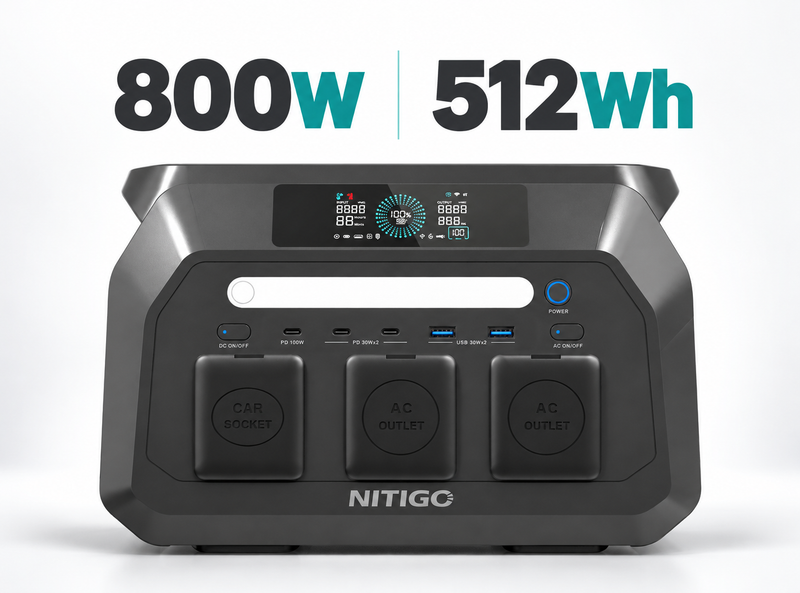
| P800 | 800W | 512 Wh | mobile, moderate loads |
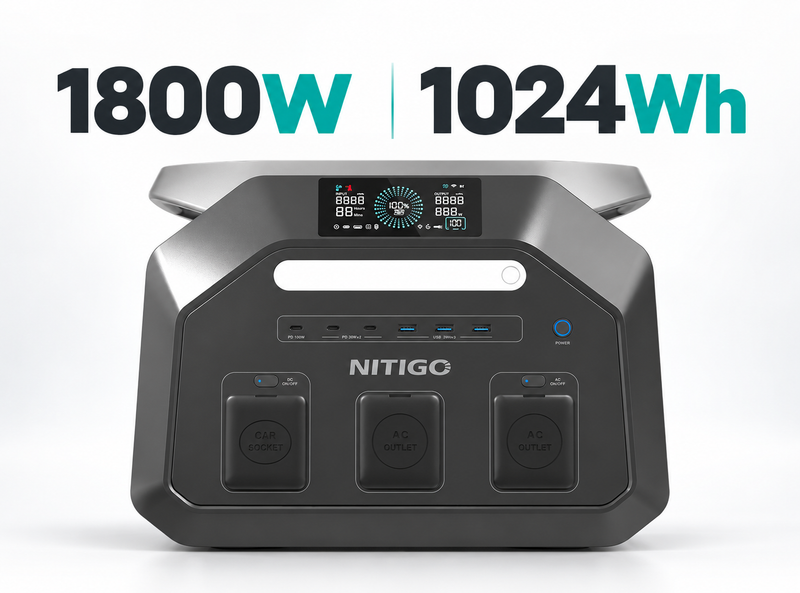
| P1800 | 1,800W | 1,024 Wh | more power reserve |
| P2400 | 2,400W | 2,048 Wh | longer term |
| P3200 | 3,200W | 2,048 Wh | higher output power |
P800 and P1800 for mobility and balanced use
Ours P800 offers 800 W continuous power, 512 Wh capacity and weighs 6.55 kg. It is therefore more suitable for mobile, moderate loads than for powerful heaters. Features include AC, USB-A, USB-C and DC outputs. The output voltage and connection equipment should be checked using the user manual for the specific version offered.
Ours P1800 offers 1,800 W continuous power and 1,024 Wh capacity. At around 12.7 kg, it is less mobile than our P800, but offers more space for a workstation, camping equipment or short, powerful consumers. Whether a specific device is suitable still depends on the starting power and the desired runtime.
P2400 and P3200 for longer runtime or higher output power
Ours P2400 is listed in the current user manual as 2,400 W and 2,048 Wh. This combination is aimed at longer runtimes and higher simultaneous loads. At around 24 kg, the wheels and pull handle become more important in everyday life than with a small station.
Ours P3200 is aimed at higher output power and is listed in our current documents with 3,200 W continuous power, 6,400 W peak power and 2,048 Wh capacity. Since equipment and version can vary depending on the offer, compare the specific version offered with the associated user manual before purchasing.
What should you check before purchasing?
Before buying, you should check the transport, noise, scope of delivery, operation and service as well as the watts and watt hours. A power station offer is only cheap if the version offered includes the required cables, connections and reliable product data.
Weight, noise, scope of delivery and operation
When it comes to transport, it helps to take into account the specific route from the basement to the car, over steps or over uneven ground. A carrying handle is more sufficient for six kilograms than for more than 20 kilograms. For the sleeping area or the workplace, fan behavior and noise under charging and discharging loads are relevant, not just a minimum value under favorable conditions.
The scope of delivery ideally includes the cables that are actually required for the planned network, vehicle or solar operation. The display, buttons and automatic switch-off should also be suitable for use. Solar accessories must be compatible with plug, voltage, current and maximum input power; a suitable plug alone does not prove electrical compatibility. Once these practical points have been clarified, service and documented product data remain the final purchase check.
Guarantee, German support and proven product data
Our user manuals bundle the model-related instructions. Before ordering, it is recommended that you compare the model number, output power, capacity, scope of delivery and warranty conditions with the actual offer. Invoice, serial number and registration confirmation should be retained; If you have any questions, our team will help you NITIGO Support further.
The safety instructions for the device also apply when charging and storing. This The Federal Environment Agency explains how to use lithium batteries safely: Avoid heat, moisture and flammable materials when charging, use appropriate chargers and plan for extended storage with approximately half charge. Damaged or deformed batteries must not be used.
Calculate needs and compare models specifically
The following matrix condenses the selection without generally declaring a specific model the winner.
| Priority | Test question | Decision rule |
|---|---|---|
| Performance | What is going on at the same time? | The total plus reserve must be below the continuous output. |
| Capacity | How many hours? | Calculate watts × hours and plan for losses. |
| peak load | Do engines or compressors start? | Compare starting value and permissible peak. |
| Everyday life | How is it loaded and carried? | Check connections, charging methods, weight and noise. |
Then you can current NITIGO power stations compare based on your own calculation. If two models meet the need, the more practical compromise between reserve, weight, charging time and price decides.
Frequently asked questions
Can a power station be taken on a plane?
Generally not as passenger luggage. The power stations mentioned in this article have a capacity of significantly more than 160 Wh. According to EASA regulations, lithium-ion batteries above this limit may not be regularly carried by passengers in hand or checked luggage. If transport is necessary, ask the airline in advance about the applicable freight regulations.
What should you do after a fall or strong impact?
Turn off the power station and check the housing, connectors and battery for deformation, cracks, unusual heat or unusual smell. Stop charging or using the device if any damage is apparent. Please contact our support before using it again. Do not open or repair the battery yourself.
Can a power station be stored in the car in winter?
Only within the storage temperature range specified in the user manual. A parked vehicle can become very cold, damp or surprisingly warm when exposed to sunlight. Therefore, remove the power station from the vehicle if the permissible storage conditions cannot be reliably maintained. Before charging, allow a device that has cooled down to reach the permissible operating temperature.
How is a used power station disposed of?
It does not belong in the household waste. Hand in the complete device at a suitable municipal collection point or a designated collection point. In the event of damage, bloating or leakage of substances, the staff should be expressly informed of this before handover.
Can a power station remain permanently connected to the power grid?
Only if the user manual for the specific version expressly provides for this operating mode. A UPS function does not automatically mean that every load or every permanent connection type is enabled. Pay attention to the switching time, continuous load, ventilation and the specifications of the connected device.