

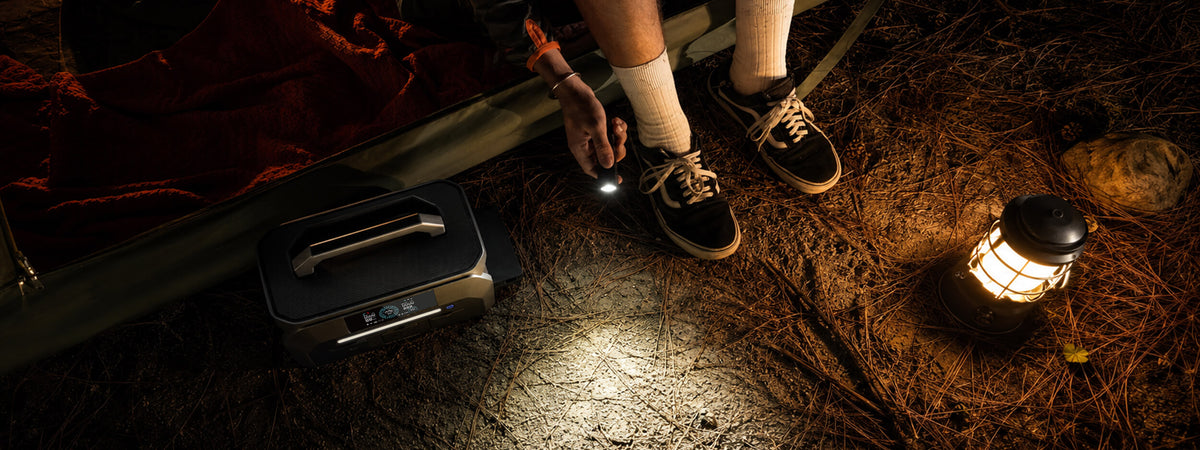
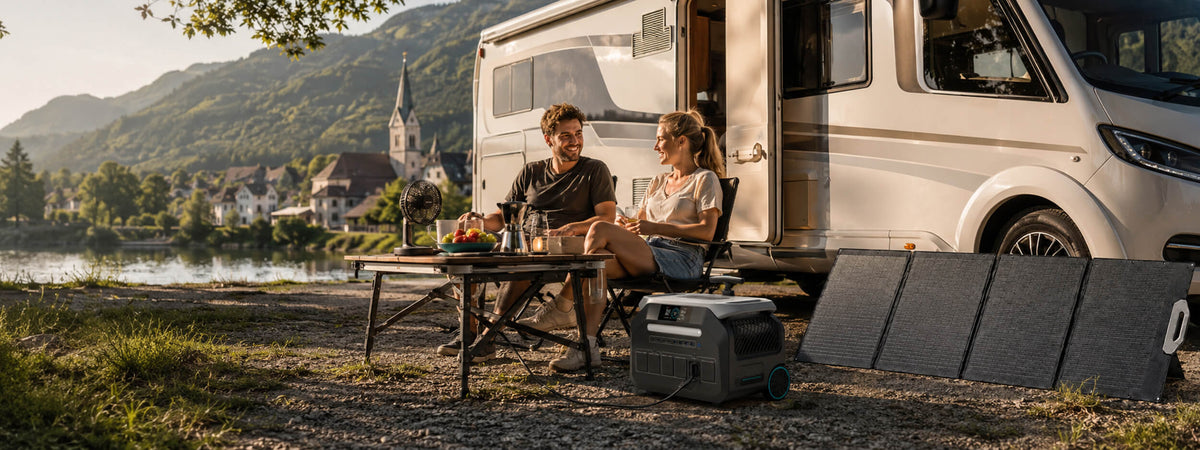
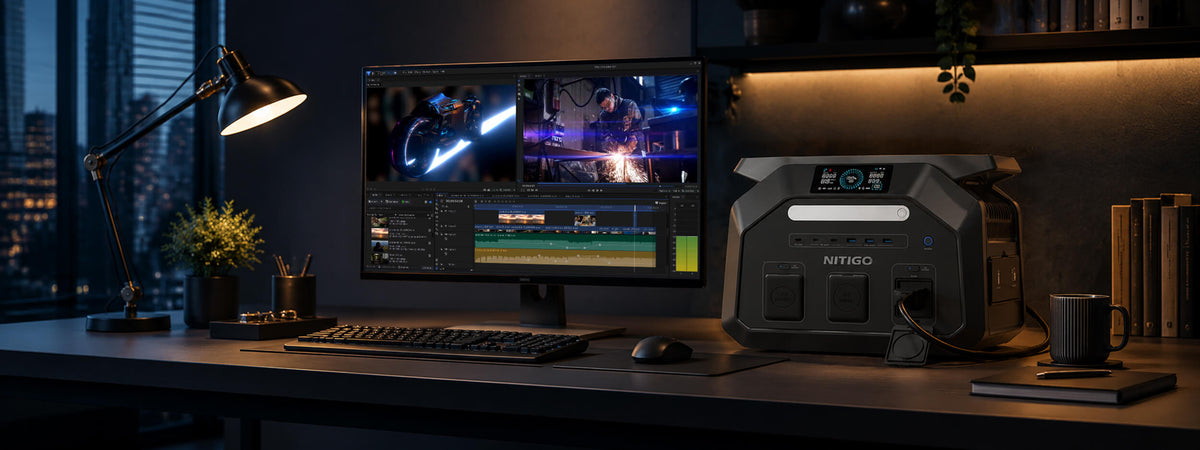

When packing for a weekend of camping, having a large reserve of energy sounds tempting. But on the way from the parking lot to the parking space it becomes clear whether the power station is really portable. A compact power station can be lifted out of the trunk and carried over short distances. From around 20 kilograms onwards, mobility usually becomes a question of wheels, flat ground and a second person.
The right size cannot therefore be determined by watt hours or external dimensions alone. What matters is how far and how often you move the device, which appliances are actually running and whether the vehicle does most of the transport. The first step is to take an honest inventory of the weight, shape and transport route.
What does the mobility of a power station depend on?
Mobility arises from the interaction of weight, dimensions, handles and weight distribution. The same portable power station can be easy to handle in an RV, but becomes impractical on a long walk. Therefore, evaluate the device based on how you will actually move it later.
Evaluate weight, dimensions and weight distribution together
A compact housing only helps if it can be safely gripped. A central, sufficiently large handle holds the load closer to the body; Side handles can make lifting easier for two people. Wide or deep devices more easily hit legs, doors and seat edges when climbing stairs.
This short check shows whether the data sheet fits your everyday life:
- Can you lift the weight from the ground to trunk height in a controlled manner?
- Do the handle and controls remain easily accessible and protected when carrying?
- Does the housing and cable pocket fit in the provided storage space?
- Can the station stand on the parking space so that it cannot tip over and is dry?
Distinguish between short transfers and longer transport routes
Two meters from the vehicle to the tailgate is not comparable to 300 meters over gravel. A heavier model can also be mobile enough for short transfers. If you carry it frequently, use stairs or use public transport, the weight should be significantly lower and the load should remain close to your body.
The ADAC test of mobile power stations assesses portability as part of handling. This underlines an important point: mobility is a usage feature, not just a product name.
Which size suits your usage situation?

The right size depends more on the intended use than on the “small power station” label. If you almost exclusively move the device in your vehicle, you can accept more capacity. When it comes to changing jobs or carrying items over longer distances, every kilogram counts.
Compare campsite, vehicle trip and mobile work deployment
The following matrix separates typical situations according to movement and energy requirements. It is an orientation, not a fixed weight limit.
| situation | Typical transport | Priority | Sensible trend |
|---|---|---|---|
| Campsite | Car to parking space | Balance between runtime and wear | compact to medium |
| Vehicle travel | usually in the trunk | Capacity and secure stand | medium to large |
| Mobile working | Office, train, stairs | low weight and small dimensions | rather compact |
| Garden or workshop | short distances on site | Performance and robust handling | medium, if necessary with rollers |
Consider transport by hand, trunk or trolley
Plan the entire journey, not just the journey. This includes lifting over the loading edge, steps at the destination, unpaved paths and daily positioning. A trolley helps on slippery floors, but requires space and secure attachment in the vehicle.
Test the intended storage space with the external dimensions and leave room for air circulation according to the instructions. Cables should be separated so that plugs do not hit the display or housing.
How does capacity affect size and weight?
More watt hours usually means more battery cells and therefore more weight and volume. The smallest power station therefore only makes sense if its usable energy supplies your devices until the next charging opportunity. Determine the need first, then the reserve.
Derive required watt hours from devices and usage time
Multiply each device's power consumption by its usage time and add the results. For fluctuating consumers such as cool boxes, measured daily values are better than the maximum nameplate performance.
A simplified example for a working day on the go:
| device | Invoice | Daily requirements |
|---|---|---|
| Laptop | 60W x 4H | 240 Wh |
| monitor | 25W x 3H | 75 Wh |
| routers | 10W x 8H | 80 Wh |
| Smartphone | 1 full charge | approx. 15 Wh |
| Total | approx. 410 Wh |
Then proceed in three steps:
- Calculate the daily requirements of all devices in Wh.
- Consider conversion losses and an appropriate buffer.
- Check whether grid, vehicle or solar charging is available along the way.
Balance additional capacity reserve against increased weight
A reserve prevents small deviations from immediately leading to a power outage. However, you carry too much reserve with you on every trip. If you can recharge daily, a moderate reserve is often more sensible than doubling the capacity.
Also consider that usable AC energy may be less than the nominal battery capacity due to inverter and self-consumption losses. Therefore, do not plan until the last watt hour.
How much output power do you really need while on the go?
The output power must cover the devices being operated at the same time, not a theoretical wish list. A high wattage does not make the power station more durable if the capacity remains the same. Above all, it increases the selection of operable consumers.
Adjust continuous power to the devices used
Add up the wattages of all devices that will run in parallel. The laptop, monitor and router from the example together require around 95 W. One 800W class already offers significant scope for this; Hotplates, kettles or power tools may require a different class.
Before making your selection, a second list will help:
- Which devices are actually running at the same time?
- Which outputs are required: 230 V, USB-C, USB-A or 12 V?
- Can a device be charged directly via DC or USB instead of via the inverter?
Plan short-term start-up performance specifically
Compressors, pumps and motorized tools can briefly draw more power when starting. To do this, check the device documents and the permissible peak power of the power station. A huge reserve without a specific consumer usually only increases weight and costs.
Which design makes transport easier?
A transport-friendly design keeps the load controllable and protects connections when moving. Handle position, housing shape and footprint are more important than decorative details. Rollers only help where the ground and thresholds are involved.

Assess the carrying handles, handle position and housing shape
A firm top handle is suitable for compact devices and short distances. Two side handles distribute a heavy load between two people. Rounded edges and a casing that doesn't swing against the leg make it easier to carry, but should always be evaluated in conjunction with actual weight.
Compare castors, trolley solutions and secure standing
Rollers reduce the lifting work on smooth surfaces, but not when loading or on stairs. Small hard wheels can block on gravel. Also check whether the pull handle and wheels are fixed when stationary and whether the device can be securely secured in the vehicle.
After § 22 of the Road Traffic Regulations Loads must be stowed and secured in such a way that they do not slip, fall over or roll around in the event of emergency braking or sudden swerving. Therefore, place a power station low and stable and use suitable lashing points or restraint systems.
Which portable power station suits your mobility profile?
For frequent wear, the lightest, sufficiently powerful class is usually the better choice. The capacity in the vehicle can increase as long as loading and securing remain realistic. The current NITIGO data shows how quickly weight and size grow with capacity.
Compare models by capacity, weight and dimensions
The table uses consistent information from the German NITIGO pages and manuals.
| model | Capacity | Weight | Dimensions | Mobility profile |
|---|---|---|---|---|
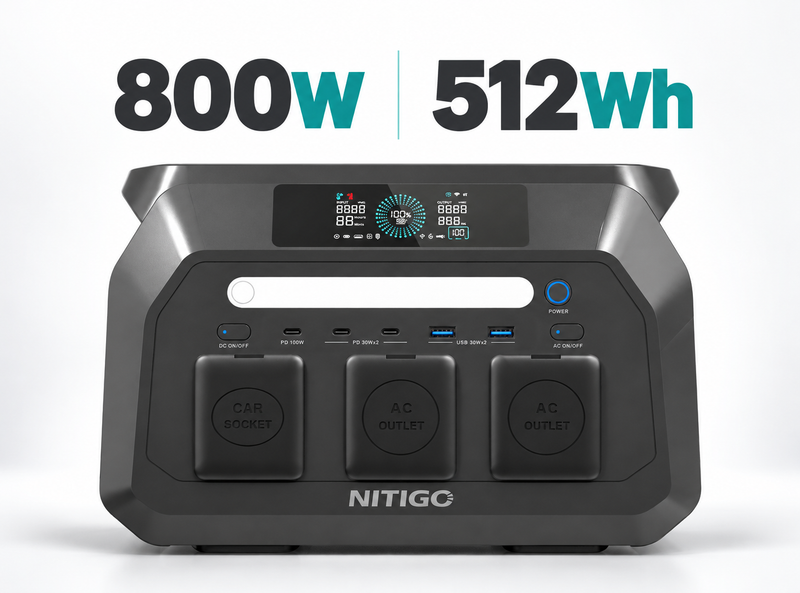
| NITIGO P800 | 512 Wh | 6.55kg | 299 × 196.6 × 191.4mm | frequent wearing, short use |
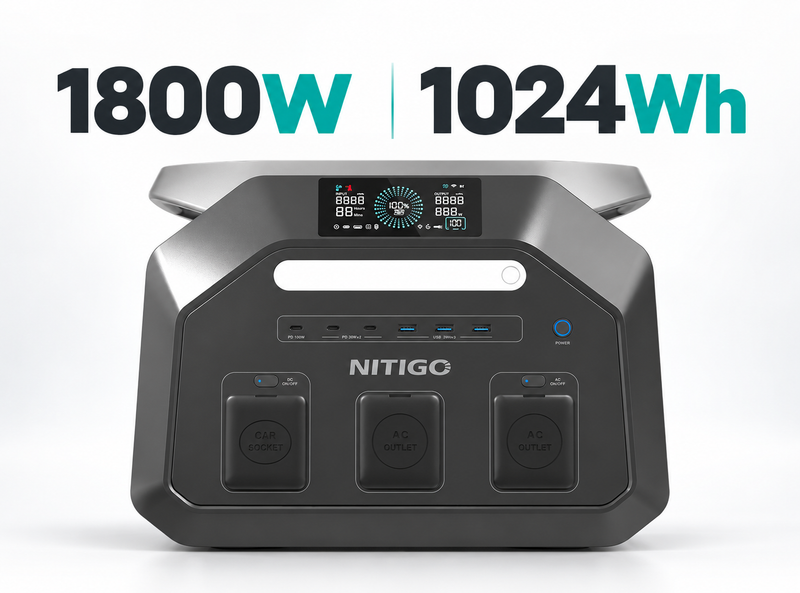
| NITIGO P1800 | 1,024 Wh | 12.7kg | 361 × 269 × 233mm | Vehicle travel, medium distances |
| NITIGO P2400 | 2,048 Wh | 24kg | 445 × 298 × 371mm | close to the vehicle, roles make sense |
Whether a power station is small enough always depends on the transport route and usage. For frequent carrying, the P800 class is closer to true hand mobility. The P1800 class remains liftable for many people, but is a better fit for paths close to vehicles. At 24 kg, the P2400 class should primarily be rolled, lifted by two people or used permanently in the vehicle area. For further connection and input data you should NITIGO user manuals check the exact model. If the model version is unclear, this helps NITIGO online support, without mixing data from similar devices.
Compare NITIGO power stations
Don't choose the largest model first, but rather the smallest class that reliably covers your real needs. This order keeps the decision clear:
- Determine use and longest transport route.
- Calculate daily energy and simultaneous performance.
- Practically check the weight, dimensions, handle or roller solution.
- Compare connections, charging options and model manual.
Then compare them NITIGO Powerstation Overview according to capacity, performance and form of transport. Then check the current availability in the German shop. This means that the mobile power station remains a useful travel companion and does not become a burden that only travels because of an unused reserve.
Frequently asked questions
Q1 Can a portable power station be taken on a plane?
Most of the time no, if it is a typical power station with several hundred Wh. There are three international levels for lithium batteries: up to 100 Wh without approval, 100-160 Wh only with the prior consent of the airline, over 160 Wh generally prohibited. Additionally, check the airline rules before traveling.
Q2 How should a power station be secured while driving?
It should be low, upright and form-fitting and secured with suitable straps or restraint systems to prevent slipping and tipping over. Connections must not be subjected to loads.
Q3 Can a power station be stored permanently in the vehicle?
No, not without checking the permissible storage conditions. Vehicles can heat up or cool down significantly; Pay attention to the temperature range, charging status and storage instructions of the exact model.
Q4 Are power stations with wheels automatically easier to transport?
No, wheels are particularly helpful on flat, firm surfaces. For stairs, high loading sills, sand or gravel, weight, grip position and, if necessary, a second person are crucial.
Q5 How do you move a heavy power station on uneven terrain?
The safest option is a suitable transport trolley with large wheels and reliable fixation. Avoid jerky pulling, protect connections and lift heavy equipment with two people if necessary.