



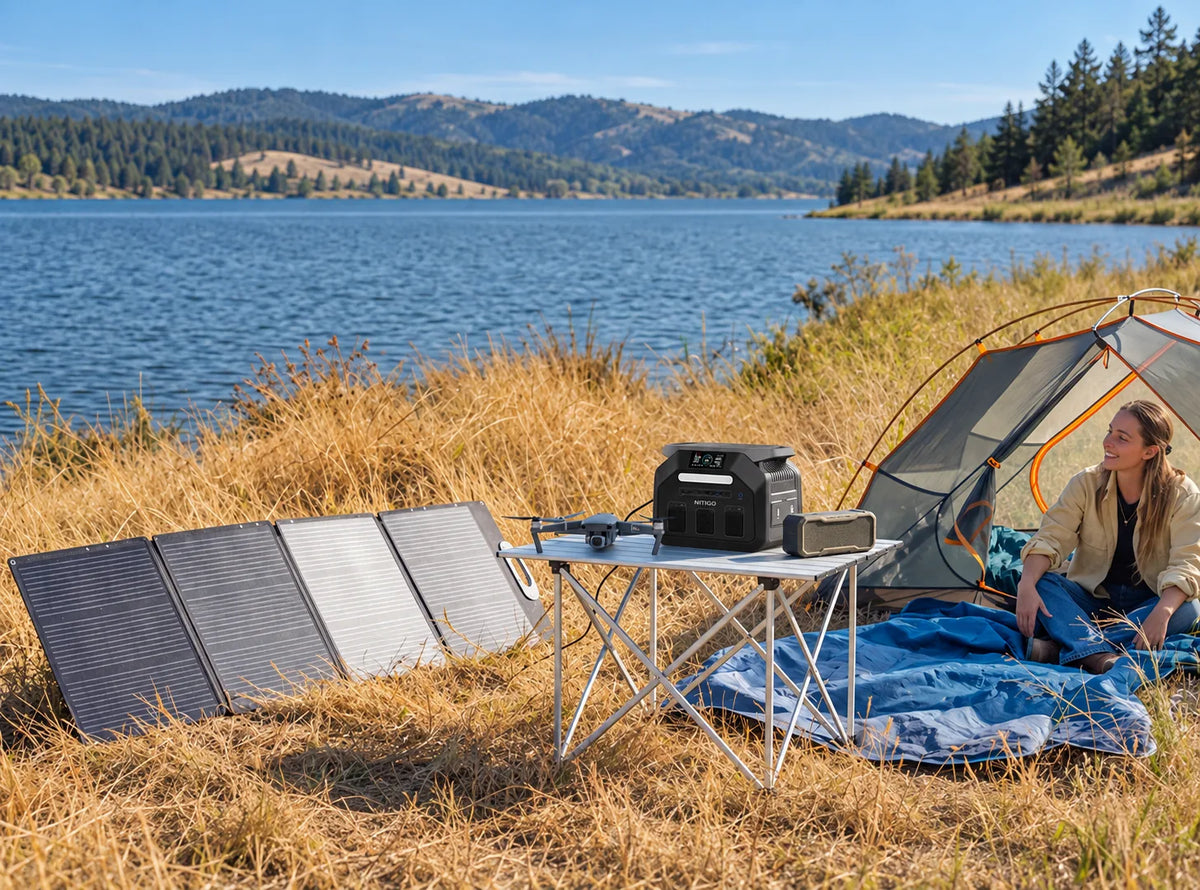
A sunny camping day offers good conditions for recharging a power station with solar energy. The position of the sun, orientation, cell temperature and possible shading ensure that the input power changes over the course of the day.
The stated 200 watts refers to the nominal power determined under standardized test conditions. Realistic charging planning is therefore based on the energy, which the panel generates over several hours, and not just at the briefly displayed peak value.
The following guide first shows you how to estimate the possible daily yield. You will then learn how to check compatibility with your power station and calculate the expected charging time.
How much electricity does a 200 watt solar panel produce in practice?
Under favorable conditions, a 200 watt solar panel can achieve an instantaneous output close to 200 watts. Over the course of the day, the input power is usually lower and fluctuates. The usable daily yield results from the actual output over time and is given in watt hours, or Wh for short.
What does 200 watts mean under standard test conditions?
The figure 200 W is the nominal power under standard test conditions, the so-called STC. This includes, among other things, an irradiance of 1,000 W/m², a module temperature of 25 °C and a defined light spectrum. Fraunhofer ISE explains the standardized test conditions and points out that the actual operating conditions often differ. The number is therefore suitable for comparing panels, but is not a promise for every location.
How do weather, orientation, temperature and shade affect yield?
Direct sun and radiation that falls as vertically as possible increase performance. Clouds reduce the direct component, but leave diffuse radiation.
The German Weather Service therefore describes global radiation as the sum of direct and diffuse solar radiation. An overcast sky can also provide electricity, but usually significantly less and more unevenly.
Warm solar cells usually work less efficiently than in the 25°C test conditions. A narrow shadow from a branch, roof edge or cable can also affect individual cell areas and reduce overall performance disproportionately. The following values are calculation examples, not a guarantee of yield:
| Example situation | Medium performance | Usable time | Energy |
|---|---|---|---|
| Cloudy section | 60W | 3 hours | 180 Wh |
| Changing sun | 110W | 4 hours | 440 Wh |
| Good sunny day | 150W | 5 hours | 750 Wh |
Will a 200 watt solar panel fit my power station?
A 200 watt solar panel can be used with a power station if its electrical values are within the permissible input limits of the specific model. The statement “200 W” only describes the maximum rated power of the panel and does not confirm that the panel, cable and power station are fully compatible.
Before connecting, check in particular the open-circuit voltage, operating current, maximum solar power, plug type and polarity. The information on the panel and the limit values in the current user manual of your power station are decisive. This applies to both Solar panels from NITIGO as well as for compatible modules from other manufacturers.
What values must match for a 200 watt solar panel?
Electrical compatibility does not depend on whether the panel and power station carry the same wattage. What matters is whether the solar input can safely handle the voltage and current of the panel.
To do this, check the following information:
- Open circuit voltage: The maximum panel voltage must not exceed the permissible input voltage of the power station. Since the open-circuit voltage can increase at low temperatures, there should be sufficient distance from the limit value.
- Operating current: The output current of the panel must match the permitted input current of the power station. A higher possible panel current does not automatically mean that the power station can fully use it.
- Maximum solar power: The solar input determines how much of the possible 200W is absorbed. If its power limit is lower, the charging electronics limit the usable input power.
- Plug type and adapter: A suitable solar charging cable or a suitable adapter must securely connect the panel and power station.
- Polarity: The plus and minus poles must be assigned correctly. A mechanically suitable plug does not confirm correct assignment.
If these requirements are met, you can 200 watt solar panel can be used to charge the power station. How close the actual input power comes to 200 W also depends on sunlight, orientation, temperature and shading.
How can the NITIGO SP200 be classified?
Our SP200 is a foldable 200 watt solution for mobile solar charging. The panel works with monocrystalline solar cells, achieves a conversion efficiency of up to 23 percent and, according to the current technical information, delivers 24 V at 8.33 A. MC4 connections are available for the connection.
| feature | Current information |
|---|---|
| model | NITIGO SP200 |
| Maximum rated power | 200W |
| exit | 24V / 8.33A |
| Solar cells | Monocrystalline |
| Conversion efficiency | Up to 23% |
| Connection | MC4 |
| Protection class | IP67 for the panel |
| Dimensions when folded | 610 × 608 × 45mm |
| Dimensions unfolded | 2,074 × 608 × 30mm |
| Guarantee | 24 months |
The protection class IP67 refers to the panel. This does not mean that open plug connections, adapters or the connected power station offer the same protection. Keep these components dry and observe their respective application limits.
Which NITIGO power stations can the SP200 be used with?
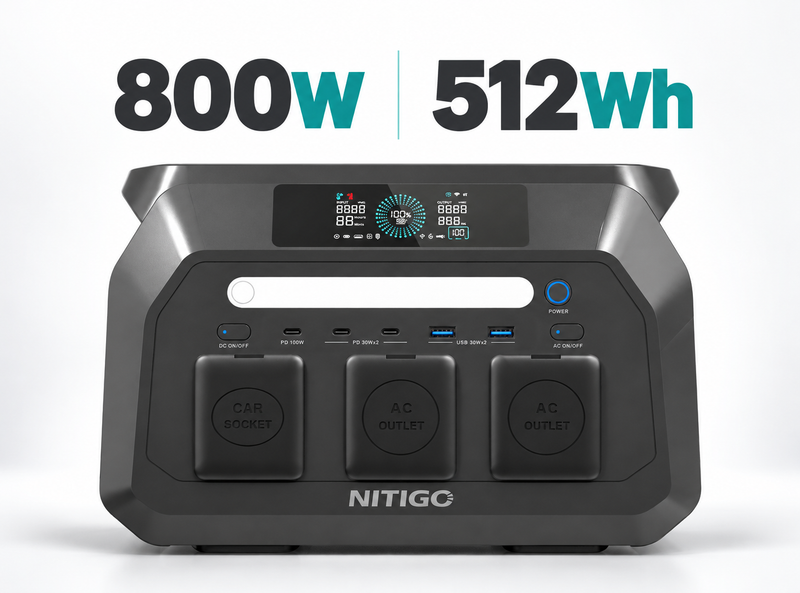
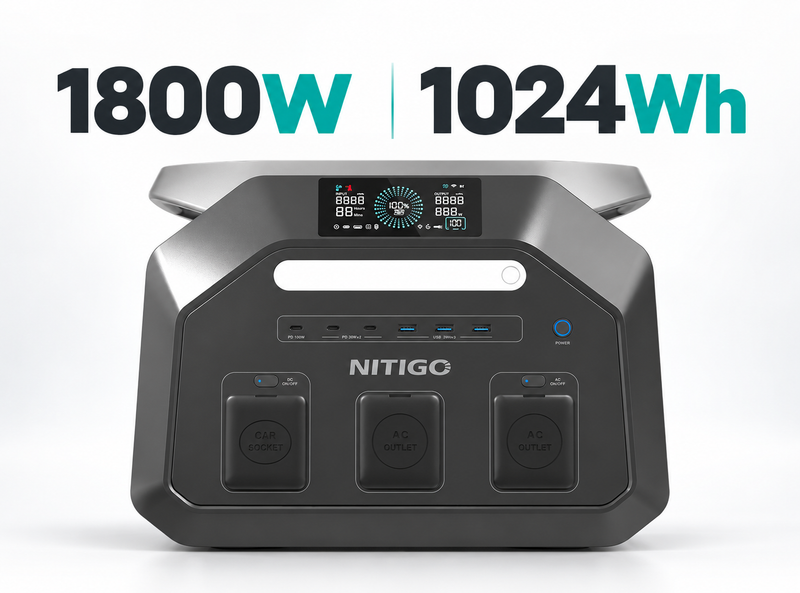
The SP200 is compatible with the NITIGO power stations P800, P1800, P2400 and P3200. For P1800 and P2400 we each have a solar set with an SP200. This The P3200 solar set contains two SP200 and thus offers a combined panel rating of 400 W. The P800 can also be connected to an SP200, but is not listed as a separate solar set.
| NITIGO power station | SP200 configuration | Common panel power rating |
|---|---|---|
| P1800 | 1×SP200 | 200W |
| P2400 | 1×SP200 | 200W |
| P3200 | 2×SP200 | 400W |
The table shows the intended panel combinations, but does not replace checking the solar input values. If there are two panels, it must also be clarified whether they can be connected in series or parallel. In a series connection the voltages add up, in a parallel connection the currents add up.
How are the panel and power station connected securely?
The SP200 uses MC4 connectors. For a different 200 watt solar panel, the connector type, assignment and electrical values may differ. Therefore, only use a solar charging cable or an adapter that is intended for both devices.
Connect in this order:
- Read the open circuit voltage, operating current and power rating of the panel.
- Compare these values with the permissible solar input range of the power station.
- Check the plug type, adapter assignment and plus-minus polarity.
- First set up the panel without any shading and in a stable position facing the sun.
- Then connect the panel to the power station and observe the displayed input power.
You can find the model-related input limits and information on wiring in our User manuals. If you have any questions about cables, adapters or compatible panel configurations, we will support you Online support.
How long does a 200 watt solar panel charge a power station?
The charging time results from the missing battery charge divided by the net solar power arriving at the battery. With 500 Wh of missing energy and an average of 125 W net power, around four hours are necessary. Charging electronics, changing irradiation and the slower final phase can extend the time.
Calculate charging time with battery capacity and actual solar power
Do not automatically calculate the total battery capacity. A battery with 1,024 Wh at 40 percent charge level still requires around 614 Wh to reach 100 percent. If a cool box is running during this time, its consumption must be deducted from the solar output.
The table assumes 140 W average panel power and a flat rate of 10 percent additional charging losses. This results in 126 W net power. This is a comparable model calculation, not measured NITIGO charging times.
| Lack of energy | Net power | Calculation value | Practical planning |
|---|---|---|---|
| 256 Wh | 126W | approx. 2.0 h | plan more than 2 hours |
| 512 Wh | 126W | approx. 4.1 hours | about 4 to 5 hours |
| 1,024 Wh | 126W | approx. 8.1 hours | often spread over two days with sufficient sunlight |
Plan clouds, shadows and conversion losses realistically
Use at least two scenarios: a good sunny day and a changeable day. The European PVGIS shows how much solar radiation varies by location, month, tilt and orientation. For a mobile panel, the calculation remains a guide because it can be implemented several times a day and local shadows are not completely predictable.
Location and monthly values can be viewed with the PVGIS of the European Commission compare.
How to properly set up a 200 watt solar panel?
Set up the panel in a stable, shadow-free manner and as directly facing the sun as possible. Then observe the input power of the power station. A small change in angle or position can have more effect than a fine theoretical calculation.
Adjust the orientation and tilt angle to suit the time of day and season
The module surface should be as perpendicular as possible to the sun's rays. Since the sun is at different heights in the morning, midday and afternoon, there is no single optimal angle for every trip. Compare two positions on the display and keep the one with the higher stable performance.
Avoid shadows, wind and unfavorable cable routing
Pay attention to these practical points when setting up:
- No branches, vehicle parts, awnings or cables over the active cell areas.
- Unfold all supports completely onto a stable surface.
- In strong winds, dismantle the panel in good time, do not weigh down the cell surface.
- Lay cables short, trip-proof, strain-relieved and without tight kinks.
What safety and application limits are important for solar charging?
The electrical limit values of the power station must not be exceeded, even in cold weather and with multiple panels. In addition, cables, housings and connections must remain protected from moisture, heat and mechanical damage in accordance with their designated protection class.
Adhere to the permissible input voltage and current of the power station
The open circuit voltage of a panel can increase at low temperatures. In a series connection the voltages add up, in a parallel connection the currents add up. Two panels may therefore only be connected if the manufacturer's documents allow the connection and the added values remain within all input limits.
Protect panel, cables and connections from moisture, damage and heat
The SP200's IP67 rating does not automatically apply to every connected connector or adapter. Before use, check the complete chain:
- Check panel surface, folds and supports for visible damage.
- Keep the plug dry and clean and do not pull it apart under tension.
- Operate the power station within the permissible temperature range and with good ventilation.
- Stop operation in the event of thunderstorms, storms, damaged pipes or unusual heating.
Choose the right solar solution
Which solar solution suits your application depends primarily on your daily energy needs, the desired charging speed and the power station used. Before purchasing, compare the battery capacity, your expected daily consumption, the available hours of sunshine as well as the permissible input voltage and input current of the power station.
Our foldable SP200 delivers up to 200W of rated power and can be integrated into a compatible solar system via its MC4 connectors. Current prices, scope of delivery and availability can be found in our Solar module overview. If you have any questions about electrical compatibility, our online support will help you.
Frequently asked questions
Q1: Does a longer solar cable affect the charging performance?
Yes, a longer cable can reduce the power arriving at the power station due to electrical losses. Therefore, use a solar cable that is suitable for the current strength with suitable plugs and correct polarity. The connection should be as short as possible and free of damaged or loose contacts.
Q2: Why does solar output remain low despite direct sun?
Unfavorable alignment, heated solar cells, dirt or limited input values of the power station can reduce the performance. Realign the panel and then check the cables, adapters and display. If the value remains unusually low, compare the panel data with the permissible input values of the power station.
Q3: Can a 200 watt solar panel be used behind a window pane?
In principle, the panel can also generate electricity behind glass, but the output is often lower there. Reflections, coatings, an unfavorable angle of incidence and the resulting heat affect the yield. A free outdoor installation usually provides better conditions.
Q4: How to transport and store a foldable solar panel?
Before folding, completely separate the panel from the Powerstation and allow damp surfaces to dry. Cables should be stored without tight kinks. Store the folded panel in a dry and protected place without placing heavy objects on it.
Q5: Can I operate devices at the same time while solar charging?
Yes, provided your power station supports simultaneous charging and discharging. However, ongoing consumption is deducted from the solar output. For example, if 130 W arrives and the connected devices require 50 W, there are approximately 80 W left to charge the battery before further losses.