


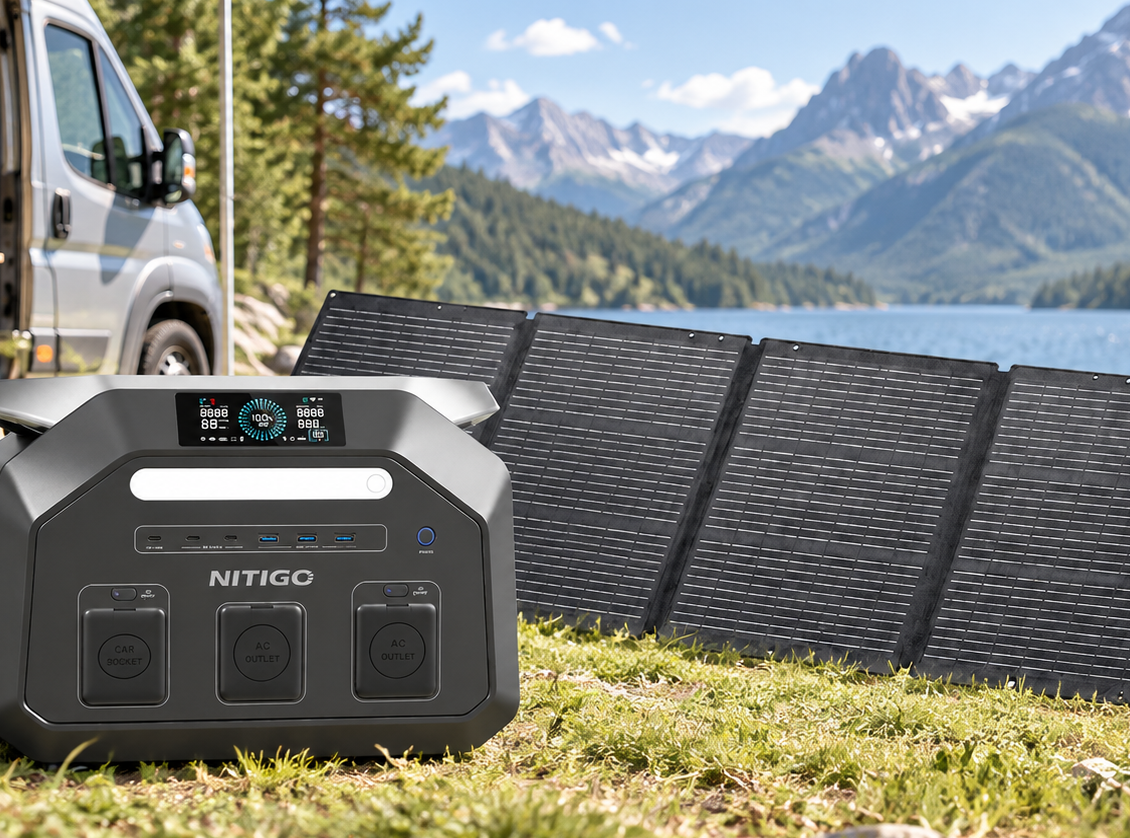
A power station with a solar panel fits your needs if three dimensions match: the daily energy consumption, the permissible solar input values of the power station and the panel output that can be achieved under real conditions. For mobile use with manageable consumption, a compact set usually makes more sense; For longer periods of self-sufficiency, multiple devices or high loads, more storage capacity and often more solar power are required.
The wattage in the product name alone does not answer this question. The name “Power station with solar panel 3200 watts” primarily describes the possible AC output power of the station, not the charging power of the panel. The following guide therefore shows how you can evaluate performance, compatibility, charging time and setup together and which set suits typical application profiles.
What does a power station with a solar panel do under real conditions?
The real solar output is often lower than the rated output of the panel because it is measured under specified laboratory conditions. What is important is not a single peak value, but rather how many watts actually arrive at the solar input over several hours.
Rated power under standard conditions
The nominal power of a module is determined under standard test conditions. This includes 1,000 W/m² irradiation, a cell temperature of 25 °C and a defined light spectrum. Our 200W SP200 solar panel can achieve this value under appropriate conditions, but it is not a guaranteed continuous performance in everyday life.
Three separate values help for practical planning:
- Panel power rating: the maximum power in watts determined under standard conditions.
- Instantaneous input power: the value that the power station display currently shows.
- Daily yield: the energy charged over the day in watt hours, which is crucial for self-sufficiency.

The Federal Environment Agency provides background on the standardized measurement conditions. In practice, the design should therefore be based on a reserve instead of equating nominal output and daily yield.
Influence of weather, angle and temperature
Direct sun, a free module area and a favorable angle of incidence increase performance. Thin clouds can already significantly reduce yield, while harsh partial shadows on a cell area can affect the performance of the entire panel more than expected.
These factors explain the most common deviations from the data sheet:
- position of the sun: The light hits the panel flatter in the morning and evening.
- Cloud cover and haze: less direct radiation reaches the solar cells.
- Cell temperature: strong heating can reduce electrical performance.
- Shading: Branches, chairs, vehicle parts or cables can cover individual cell areas.
The consumer advice center also explains the influence of alignment and shading. With a mobile panel, this disadvantage can often be directly reduced by tracking and a free location.
Is a solar panel compatible with the Powerstation?
A panel is compatible if the voltage, current, power, connection and polarity are within the specifications of the power station. The fact that a plug fits mechanically or that an adapter is available is not sufficient proof.
Open circuit voltage, working voltage and input current
The open circuit voltage Voc is the highest panel voltage without load and must remain below the maximum permissible input voltage of the station even at low outside temperatures. The working voltage Vmp is present when operating at the maximum power point; The MPPT controller uses them to gain as much charging power as possible from changing irradiation.
The following order is recommended for the test:
- In Power station manual Determine the permissible voltage range as well as the maximum current and maximum solar power.
- On the panel nameplate Voc, Vmp, Isc and Imp read, not just the wattage.
- If there are several panels, recalculate the values for series or parallel connection.
- Only use a configuration that meets all limits with reserve.
The voltages add up in series and the currents add up in parallel. Too high a voltage can damage the input; A higher available current is only justifiable if the manual and charge controller expressly allow this configuration.
Plugs, adapters and correct polarity
Ours SP200 uses MC4 connectors. A suitable solar charging cable or an approved adapter may still be necessary for the power station, whereby plus and minus must be assigned correctly throughout.
Before connecting, these points are particularly relevant:
- The connector system and counterpart form an approved, matching connection.
- The adapter is designed for the voltage and current of the planned configuration.
- The polarity marking on the cable matches the solar input of the station.
- Contacts are dry, clean, fully engaged and free of tensile stress.
For PV connectors DKE points out the manufacturer assignment and correct assembly. If you are unsure, the original cable from the set is the lower-risk choice.
How long does it take to charge the power station via solar?
The charging time is approximately calculated from the energy still to be charged divided by the real input power. Since the sun and charging power fluctuate, the result is a planning variable and not a firm commitment.
Calculate charging time from capacity and real input power
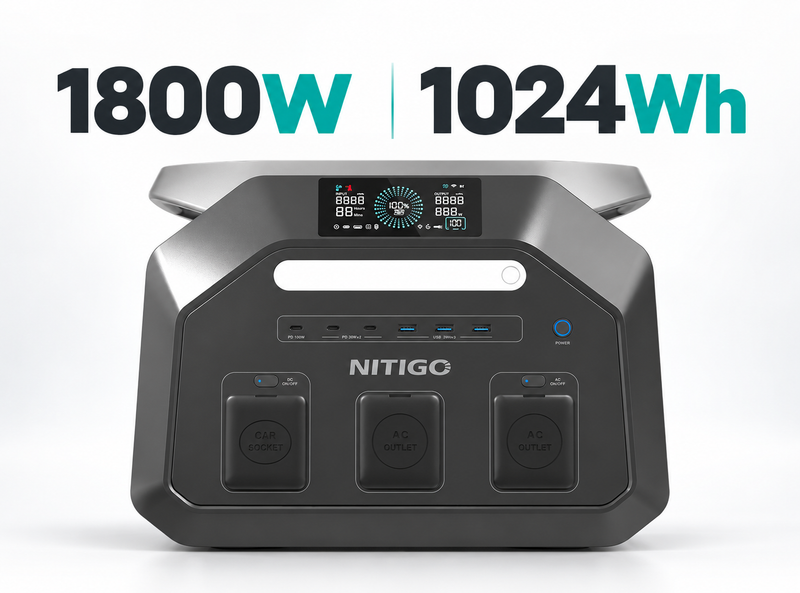
For a rough calculation, the missing energy is first determined. One P1800 With 1,024 Wh capacity, with 20 percent remaining charge, it mathematically requires around 819 Wh to reach the nominal capacity.
The calculation can be understood in three short steps:
- Missing energy: Capacity × missing charge share, i.e. 1,024 Wh × 0.80 = 819 Wh.
- Ideal loading time: missing energy ÷ real input power, approximately 819 Wh ÷ 150 W = 5.5 hours.
- Practice reserve: Allow additional time for weaker sun, control losses and the slower charging phase close to 100 percent.
For a single SP200, a real instantaneous power of 150 W is only a calculation example, not a guaranteed value. For example, if the display shows 110 W for a longer period of time, the calculated time for the same amount of energy increases to around 7.4 hours.

Reserve for clouds, shadows and conversion losses
A portable power station with a solar panel should not be planned so tightly that it only works on a cloudless day. It makes more sense to have an energy balance over the day of use: device consumption and self-consumption are compared with the realistic solar yield.
More reserve is particularly important when:
- a cool box or router continues to run around the clock,
- the location is often shaded or the panel cannot be tracked,
- should be charged in spring, autumn or winter,
- the power station simultaneously supplies devices while charging.
How is the solar panel set up correctly?
A mobile solar panel delivers the most when its surface faces the sun as directly as possible and remains completely free. Small location adjustments throughout the day often do more good than putting an unnecessarily large panel in a bad location.
Avoid orientation, tilt angle and shadows
For mobile use, it is not a fixed year-round number that counts, but rather the current position of the sun. The panel can be tilted so that the sun's rays hit the surface as vertically as possible; A quick comparison of the display performance helps with fine-tuning.
A simple routine makes setup easier:
- Choose an open location without moving shade.
- Unfold the panel completely and align it stably towards the sun.
- Read the input power after a few minutes and vary the angle slightly.
- Observe the shadow pattern and plan one or two changes of location if you use it for a longer period of time.
Wind protection, cable routing and relocation
Folding modules offer the wind a large surface area to attack. The supports should therefore stand firmly, without covering ventilation or active cell surfaces; If there are strong gusts, a more sheltered location makes more sense than a risky maximum inclination.
The cable runs as far as possible without any tight kinks, pinch points or tripping hazards. The power station itself remains within the permissible temperature range on a dry, ventilated surface, while only the panel designed for this purpose is left outside.
Which NITIGO solar set is suitable for use?
For mobile consumers and moderate daily consumption P1800 plus SP200 the obvious combination. P2400 or P3200 is a better fit when more devices, higher concurrent performance, or longer reserves are important; then the available solar area should also fit the larger station.
SP200 with P1800 for mobile use
Our SP200 delivers up to 200W at 24V and 8.33A, uses monocrystalline cells and is foldable. Our P1800 offers 1,024 Wh capacity, 1,800 W continuous power and a solar input up to 500 W; According to the technical data on the corresponding product page, 12 to 60 V and a maximum of 10 A apply.
The set is suitable, for example, for a laptop, light, camera batteries, router or an economical cool box. However, whether daily consumption is compensated for by solar energy depends on the runtime, weather and actual input power.
SP200 with P2400 or P3200 for higher energy requirements
Ours P2400 and P3200 are intended for higher load classes. According to the technical data on the respective product pages, both models support a solar input of up to 1,000 W at 12 to 80 V and a maximum of 16 A; We also offer a set with two SP200 for our P3200.
The most important differences can be classified as follows:
When selecting, the highest simultaneous load counts first, then the daily energy requirement and only then the number of panels. Compare the required capacity and solar power with the data of the selected model version in the NITIGO user manual.

What safety limits apply to solar charging?
When charging solar, the maximum permissible voltage, current and input power of the power station must not be exceeded. In addition, cables, plug contacts, installation surface and environment must be suitable for the intended use.
The official set and the associated instructions provide the relevant configuration. Safety measures or adapters do not replace checking the electrical limit values.
Avoid moisture, damaged cables and hot surfaces
Our SP200 is included IP67 rated, but it does not follow from this that every plug connection or the connected power station has the same protection. A foldable solar panel should therefore not be intentionally left in the rain, and open contacts should only be connected or disconnected dry.
Damaged insulation, discolored connectors, loose contacts or unusual heat are reasons to stop charging. The power station also does not belong in a closed, heated vehicle or directly on a hot surface.
Frequently asked questions
How to properly clean a foldable solar panel?
Before cleaning, completely disconnect the panel from the Powerstation. Remove loose dust with a soft cloth and only use cleaning products approved in the user manual. Abrasive tools, aggressive cleaners and water on open plug contacts can damage the surface or the connections.
How should the solar panel be stored between uses?
Store the panel clean, dry and without heavy objects on it. Only fold it in the designated places and protect cables and connectors from pulling, crushing and dirt. Before the next use, the surface, seams and connections should be briefly checked for visible damage.
Can a solar panel charge behind a window pane?
In principle, light behind glass can produce a low charging output, but the yield is usually lower than when placed freely in direct sunlight. In order to plan solar charging, the panel should be positioned freely outside while the power station remains dry and sufficiently ventilated.
How can the actual daily yield of the solar panel be determined?
Use the power station's energy display or charging history, if the model provides these values. Note the charge level, time period and devices supplied in parallel under comparable conditions. Individual peak values in watts do not replace measuring the energy charged over the day in watt hours.
What should you pay attention to before connecting after a sharp temperature change?
Before connecting, wait until the panel, cable and plug contacts are dry and have adjusted to the permissible operating temperature. Visible condensation must have completely disappeared. This avoids connecting wet contacts or operating devices outside their intended temperature range.