


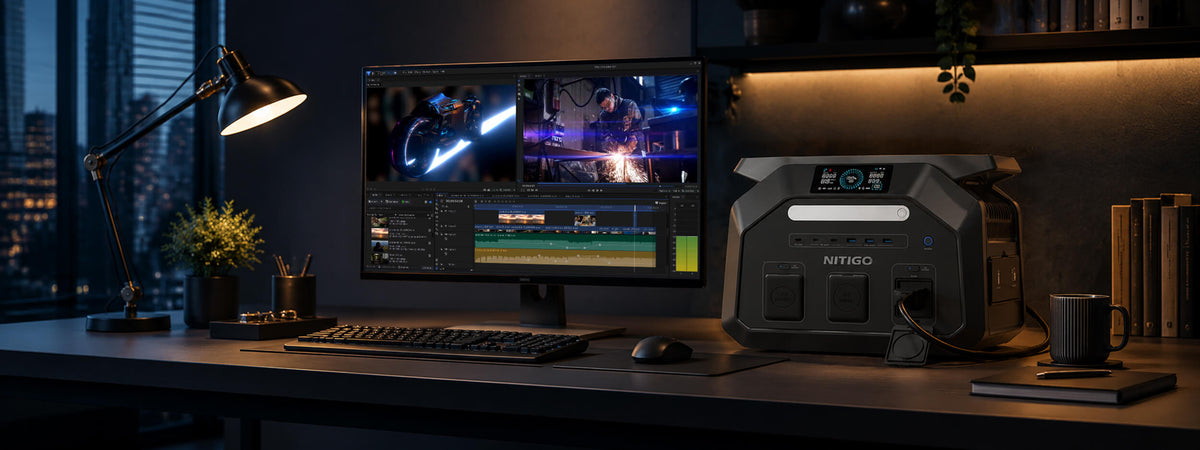
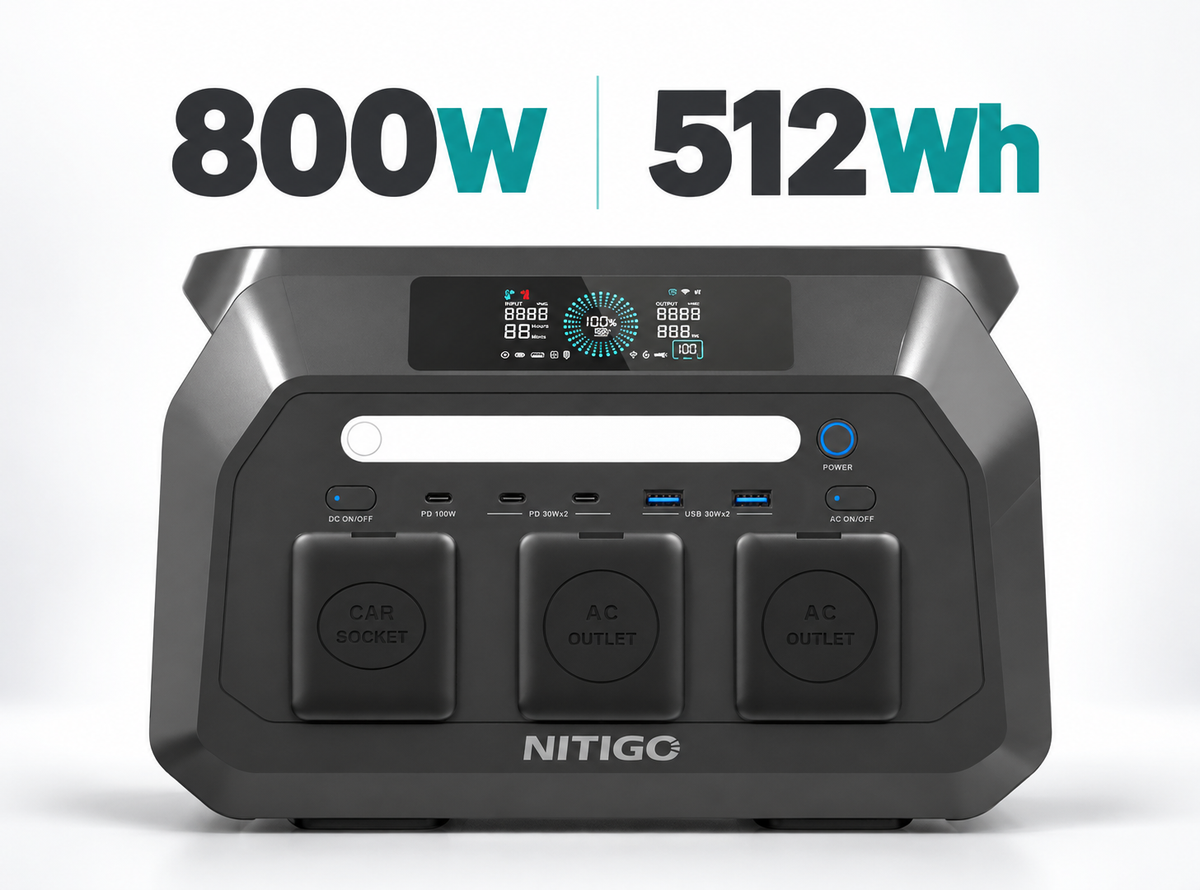
If you want to move your laptop workstation outside or don't want to do without electricity while camping, you often choose compact power packs. But what are the practical limits of an 800 watt power station with 512 Wh?
800 W refers to the maximum AC continuous power, while 512 Wh describes the amount of energy stored. Below you will find out which combinations make sense, how to calculate the runtime and when more power or capacity is necessary.
What do 800 watts of power and 512 watt hours of capacity mean?
A power station with 800 watts can supply consumers up to the permitted continuous power. The capacity of 512 Wh, on the other hand, indicates how much energy the battery stores. A device can therefore perform well and still empty the battery quickly.
Which devices are determined by the 800 watt limit?
Add up the power ratings of all devices that are turned on at the same time. For example, a laptop with 65 W, a monitor with 35 W and two LED lights with a total of 20 W result in 120 W. This combination is well below 800 W. A consumer with 1,000 W already exceeds the regular continuous output of 800 W. The NITIGO P800 Although it supports X-Boost operation up to 1,100 W for selected consumers, no general compatibility guarantee can be derived from this. The load characteristics and the requirements of the specific device are crucial.
Motors, pumps and compressors may require more power for a short time when starting. Therefore, continuous power and starting peak must match the power station.
What runtime can be derived from 512 Wh?
For planning with 230 V consumers, a conservative calculation value of 85 percent usable energy can be used. This turns 512 Wh into around 435 Wh. This factor is not a guaranteed product property, but rather roughly takes into account conversion losses and internal consumption.
The basic formula is: Running time in hours = usable energy in Wh divided by average power in W. With a constant load of 100 W, this calculates to around 4.4 hours. Temperature, battery status, output type and load history can change the result.
| Constant load | Bill with 435 Wh | Planning value |
|---|---|---|
| 40W | 435Wh / 40W | approximately 10.9 hours |
| 100W | 435Wh / 100W | approx. 4.4 hours |
| 300W | 435Wh / 300W | approx. 1.5 hours |
| 600W | 435Wh / 600W | approximately 44 minutes |
For which mobile devices is this power class sufficient?
This class is particularly suitable for electronics, lighting and selected devices with moderate performance. Typical locations are: Campsite, vehicle trip, garden, photo use or a changing workplace.
Which device combinations make sense?
A good combination remains manageable in terms of both overall performance and energy consumption. For example, it makes sense:
- Laptop, smartphone, router and LED lighting for mobile working
- Camera batteries, drone batteries and chargers for a photo mission
- 12 V cool box, light and mobile devices when camping, as long as the measured daily consumption is appropriate
- Soldering iron or small measuring device together with a work light and notebook
A USB-C enabled laptop should be charged directly via an appropriate USB-C port if the performance and charging profile match. This eliminates the need for additional conversion via a 230 V power supply.

Which consumers should be operated individually?
Devices close to the 800 W limit should not be run together with other heavy consumers. These may include small cooking appliances, heaters or certain power tools. Always check the nameplate and note possible starting peaks. Many coffee machines, kettles and hairdryers are above 800 W and are therefore not automatically suitable.
How is the runtime of a 512 Wh power station calculated?
Multiply the average power of each device by the usage time and add all the watt-hours. A 60 W laptop for four hours requires 240 Wh. Two 10 W lights for five hours require another 100 Wh. The requirement is therefore 340 Wh before losses and reserves.
How many laptop or smartphone charges are possible?
Divide the assumed usable energy by the battery capacity of the device. For a careful rough calculation, 435 Wh can also be used. This results in For a laptop battery with 60 Wh, roughly seven and for a 15 Wh smartphone battery, about 29 full charges. The actual number depends on the output used, the charging electronics, the cable, the battery status and the simultaneous use of the device.
The most reliable basis is the watt-hour specification of the respective battery. If it is missing, it can be approximately calculated with Wh = V x Ah given known volt and amp hour values.
Why does the runtime decrease under high load?
High load drains the same energy storage more quickly. High load drains the same energy storage more quickly. In addition, conversion losses occur when the inverter is operated, so that not the entire nominal capacity reaches the connected device. If consumption varies, a measurement over several hours is more meaningful than a briefly displayed maximum value.
What are the limits of an 800 watt power station?
This class is designed for mobility and moderate loads. It does not replace a permanent house installation. The terms mini power station and power station mini are used inconsistently: At around 6.5 kg, the P800 remains compact, but is not a power bank.
Why can a motor device switch off despite using less than 800 watts?
When switched on, a motor can briefly demand several times its normal power. If the peak exceeds the permissible value, the overload protection reacts. Check the consumer's rated power, starting requirement and manufacturer's information.
When does a larger power class make sense?
More power or capacity makes sense if at least one of these points applies:
- A single device requires more than 800 W permanently.
- Several consumers together exceed the permissible continuous power.
- The calculated daily requirement, including reserves, is above the usable energy.
- The station is intended to work for several days without a reliable recharging option.
Please also include the complete transport route. Our guide shows how weight, grip, storage space and distance work together.
Does the NITIGO P800 fit your mobile device needs?
Our P800 combines 512 Wh capacity with 800 W continuous power, up to 1,600 W short-term peak power and a LiFePO4 battery. At around 6.5 kg, it fits above all short mobile missions with laptop, light, chargers and other moderate consumers.


Make the decision in this order:
- Note all consumers with power and daily usage time.
- At the same time, check the required watts and possible start-up peaks.
- Calculate watt-hour requirements and add a realistic reserve.
- Compare connections, cables, charging methods and transport weight.
Then check the model-related limit values in the current one NITIGO User Manual. If you have an unclear device version or an unusual consumer, we will help you NITIGO online support. You should check current availability and offer information immediately before placing an order in the German shop.
Frequently asked questions
Can an 800 watt power station power a coffee machine?
Only if the actual power consumption and the start request are within the permitted values. Many coffee machines require more than 800 W. Therefore, do not rely on the type of device, but rather check the nameplate and instructions for the exact model.
How long does a power station with around 500 Wh last?
That depends on the average load. Assuming 435 Wh of usable energy, a constant 50 W load will run for around 8.7 hours, and a 200 W load will run for around 2.2 hours. Real values may be lower.
Can a small power station power power tools?
Yes, if continuous power, starting tip and connection are correct. Battery chargers and small electronic tools are often easier to classify than saws, compressors or pumps. Check each device individually and test it under controlled conditions.
How many devices can be connected at the same time?
It's not just the existing sockets that are important, but also the overall performance and the limits of each output. Add up all consumers active at the same time and only use suitable, undamaged cables.
When does an 800 watt power station switch off due to overload?
The protection can react if continuous load or starting peak exceed the permissible range. Then disconnect the consumers, check their values and restart according to the manual. Repeated shutdowns are a signal to reduce the load or select a higher power class.