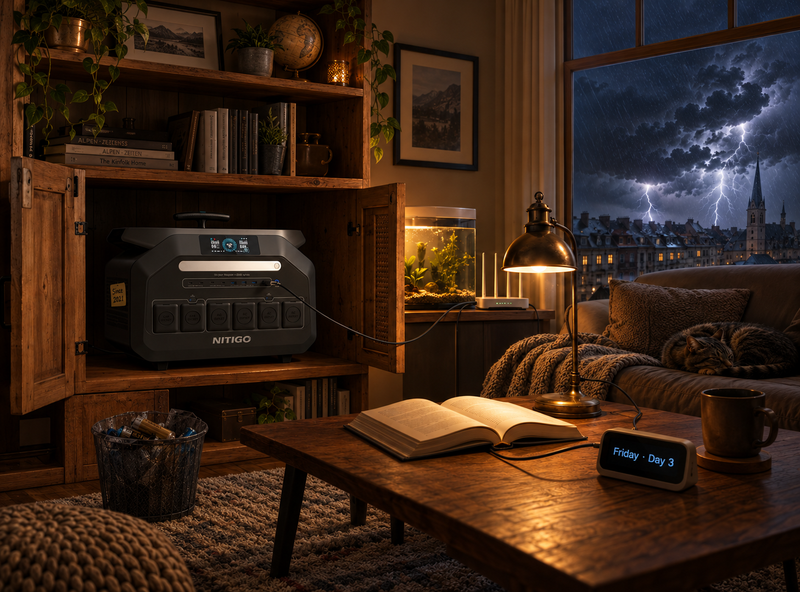


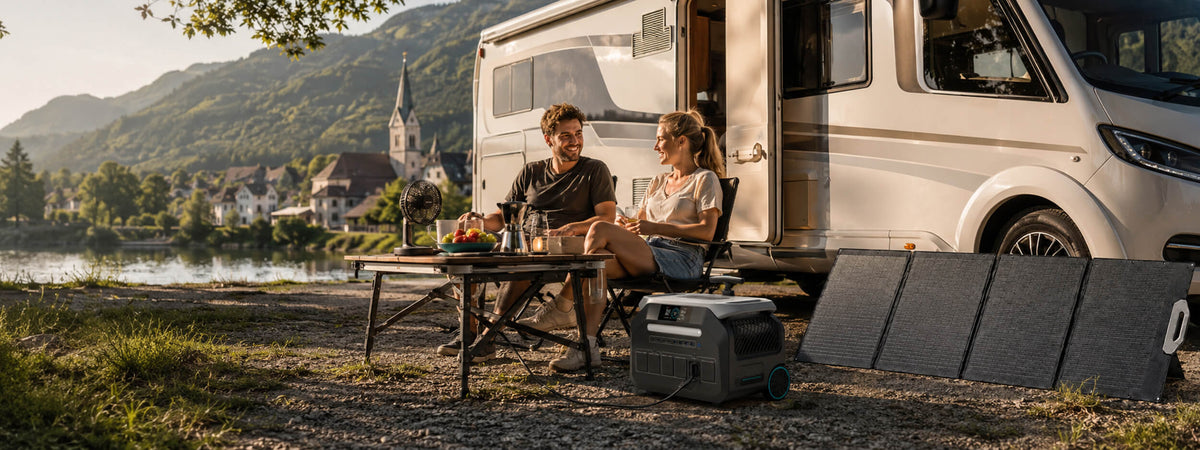

A remote parking space makes the caravan particularly quiet, but does not come with a power socket. A power station for the caravan can temporarily supply lighting, communication devices, laptops and suitable cooling devices with power, provided the capacity and output power match daily needs.
The appropriate size depends on the daily consumption, the simultaneous load and the next realistic charging option. Installation location, ventilation and safe storage are also part of the planning. The first question that arises is when mobile storage actually brings an advantage.
When does a power station make sense in the caravan?
A power station makes sense if you bridge phases without shore power or want to operate selected devices independently of the caravan complex. You charge the memory from a suitable source and connect the required consumers directly.
Bridge pitches without shore power
On natural pitches or simple camping areas, a mobile power reserve can cover basic needs. LED lights, smartphones, routers and laptops usually require significantly less energy than electric heating or cooking devices. The more consistently you separate these groups, the longer the battery will last.
Supplementary power source instead of replacing the on-board electrical system
Directly connected devices and feeding into the entire caravan electrical system are technically not the same thing. To supply individual appliances, use the power station's intended outputs. A connection to the caravan's shore power input, fixed 12V circuits or protection systems However, this requires an approved solution and expert testing.
Which devices are really part of everyday life in a caravan?
The device list should reflect the actual travel itinerary. Classify consumers by importance, duration and performance. This means that long-term consumers and briefly used devices can be clearly identified.
Separate necessary consumers from comfort devices
A practical inventory works with three groups:
- Basic requirements: Lighting, telephone, necessary communications and, if necessary, water pump.
- Work and travel needs: Laptop, camera batteries, routers or navigation devices.
- Comfort needs: Coffee machine, hairdryer, hotplate, air conditioning or electric heater.
When energy is scarce, basic needs take priority. Comfort devices remain possible if performance and energy requirements fit into the daily plan.

Distinguish between long-term consumers and short-term devices
A 40W device can consume 400Wh over ten hours. A kettle with 1,500 W only requires around 100 Wh for four minutes, but requires a much higher output power in the short term. Capacity determines the runtime, while continuous and starting power determine whether a device can even start and run stably.
How long does the caravan remain self-sufficient with a power station?
The self-sufficiency period results from usable battery capacity divided by the daily requirement. For an initial AC estimate can around 85 percent usable energy can be expected; Self-consumption, temperature and load curve change the result. Your own measurements remain more accurate than general values.
Estimate the daily energy requirements of the most important devices
Multiply the power in watts by the daily runtime in hours. The result is the consumption in watt hours. The following sample calculation must be replaced with your own measurements.
| Example consumer | Performance | Usage per day | energy per day |
|---|---|---|---|
| LED lighting | 10W | 4 hours | 40 Wh |
| routers | 15W | 6 h | 90 Wh |
| Laptop | 60W | 2 hours | 120 Wh |
| water pump | 50W | 0.2 h | 10 Wh |
| Measured cooling consumption | Measured value | 24 hours | 300 Wh |
| Total | 560 Wh |
Take refrigerators and other long-term consumers into account separately
In a refrigerator, the maximum power consumption says little about daily consumption because compressor devices switch on and off. If possible, measure for 24 hours under similar conditions. With an absorption refrigerator, the operating mode and manufacturer specifications must be taken into account separately.
Combine length of stay and suitable power station size
Multiply the daily requirement by the number of days until the next safe charge. At 560 Wh per day, two days result in 1,120 Wh. There is also a reserve for colder nights, additional charging processes or unfavorable operating conditions. One station with 1,024 Wh nominal capacity This example would not reliably cover two full days without recharging.

Plan to recharge with a solar panel as a variable addition
One Power station for the caravan with solar panel can extend self-sufficiency, but does not guarantee a fixed daily amount. Weather, shade and orientation influence yield. The ADAC guide to solar systems on campers explains module size, cable route and charging equipment. Before connecting, the voltage, current, solar power, plug and polarity must match the input.
Where should the power station be located in the caravan?
The place must be dry, stable, ventilated and accessible. Closed storage boxes without air exchange and walkways are unsuitable. Different requirements apply to operation and transport.
Set it up dry, stable and easily accessible
A flat surface prevents tipping and relieves strain on the plugs. Keep your distance from the sink, wet clothing and open windows. The display and main switch remain freely accessible.
Keep ventilation openings and operating area clear
Blankets, curtains and luggage must not cover ventilation openings. Power supplies also need space to dissipate heat. If fan operation is abnormal, check the load, temperature and airflow.
Keep your distance from heat sources and moisture
Heating outlets, direct sun behind a window and cooking areas can increase the temperature of the device. The operating and storage temperatures in the manual for the specific model are decisive. The power station does not belong in areas with condensation, splashing water or flammable vapors.
Store the power station safely before continuing your journey
Before driving, loose cables and cables that are not approved for driving are disconnected. If the power station is to be charged via a designated vehicle connection while driving, the station and cable must be securely attached. The specifications of the power station and the vehicle are decisive. Heavy objects should be placed low and as close to the axle as possible. Also DEKRA recommends deep loading close to the axle as well as securing with suitable straps. The weight of the power station counts towards the payload of the caravan.
What safety rules apply in the caravan?
In the tight interior, damaged cables, blocked ventilation and heat can all work together. Only use intact connections and stop operation if warning signs appear. Interventions in the fixed electrical installation should be carried out by a specialist company.
Use suitable cables and undamaged connections
Cables must not be bent or squeezed through doors or furniture. Add the power of all devices on a multiple socket and do not connect power strips in series. The ADAC explains risks caused by overloaded cables and recommends observing load limits and heat emission.
Stop operation if there is heat, smell or error messages
Unusual heat, deformation, smoke, sparks, fluid leaks, or a noticeable odor are grounds for immediate shutdown if it is safe to do so. Keep your distance and stop using the device. If there is smoke or fire, leave the danger area and call 112.
Differentiate direct device use from feeding into the caravan complex
A laptop connected to the AC socket of the Powerstation is a direct device use. The connection of the station to the CEE shore power input or a fixed circuit, on the other hand, affects protective conductors, residual current protection, switching and possible feedback. Do not use improvised adapters for this. A permissible solution must fit the caravan and power station and be assessed professionally.
When does a power station in a caravan reach its limits?
Limits arise from a lack of charging energy, high loads, starting currents and the weight of larger batteries. The Powerstation remains flexible for clearly defined consumers; Full supply requires a planned on-board solution.
Long stays without reliable charging options
More capacity extends the time until the battery runs out, but does not solve a permanent energy deficit. If 600 Wh is used every day and only 200 Wh is recharged, the charge level drops by around 400 Wh per day despite the solar panel. Therefore, plan for an unfavorable weather phase and an accessible alternative for recharging.
Heaters, air conditioning and hot water
Electrical heat and active cooling place particularly high demands on performance and capacity. A heater with 1,500 W consumes 1,500 Wh in one hour. Even if the output power is sufficient, the desired operating time can be significantly shorter than with light, communication or a laptop.
High continuous loads and strong switch-on peaks
Compressors, pumps and power tools can briefly require more power when starting than in normal operation. If this peak exceeds the permissible range, the protective shutdown can react. The nameplate, equipment manual and peak performance information must therefore be viewed together.
Supply of the entire caravan electrical system
The complete system includes charger, converter, fixed consumers and protective devices. To supply them, the electrical installation must be checked and an approved switching or feed-in solution selected.
Plan a power station for the caravan sensibly
The overview serves as a technical preselection. The daily requirements, simultaneous load and safely transportable weight remain crucial. Check prices and delivery conditions immediately before ordering.

| model | Classification for the caravan |
|---|---|
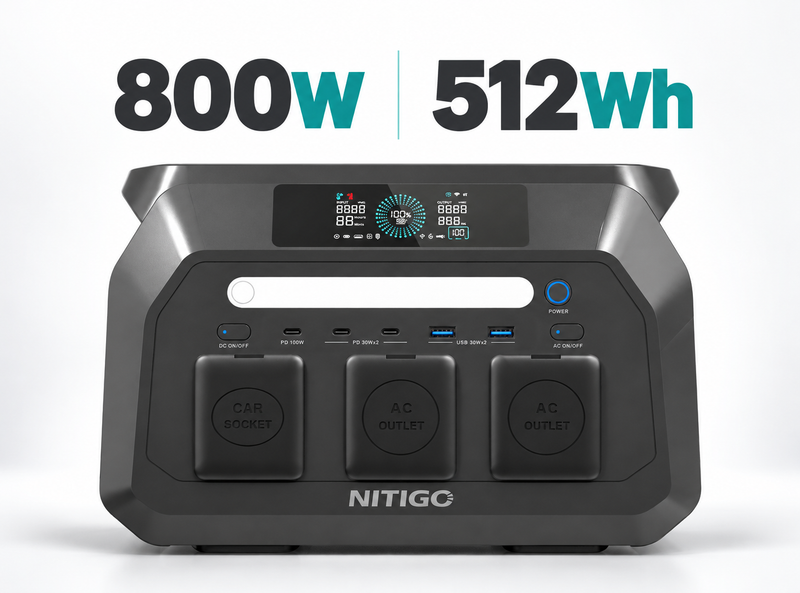
| NITIGO P800 | Short stops, light load and frequent carrying |
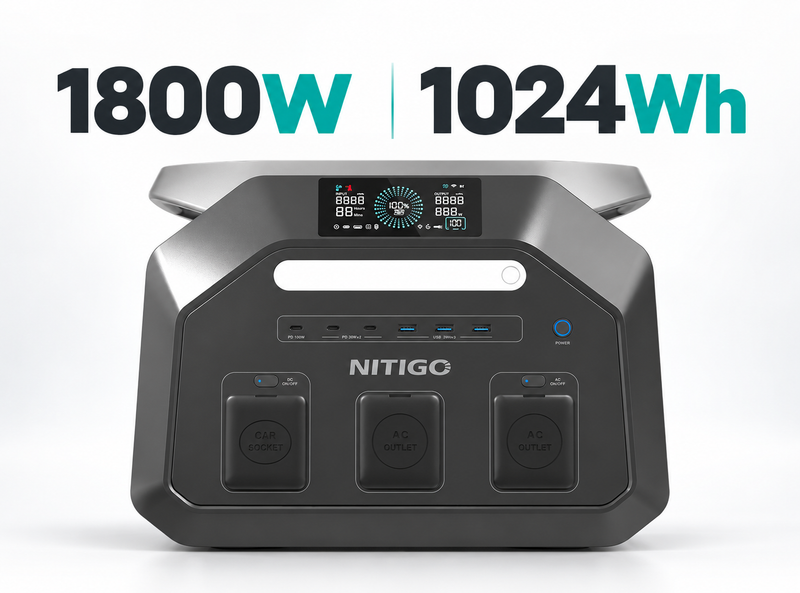
| NITIGO P1800 | Average daily requirement and more powerful individual devices |
| NITIGO P2400 | Longer service life, higher load and transport close to the vehicle |
The NITIGO P800 fits a compact basic requirement. The NITIGO P1800 expands capacity and power reserve, while the NITIGO P2400 with 2,048 Wh is aimed at longer stays and higher loads. Before making your selection, compare your device list with the current connections and limit values for each one user manual.
Next step: Record a full day of travel, add up the watt-hours, and mark all devices running at the same time. Then choose the smallest model that covers continuous power, starting peaks, desired self-sufficiency time and transport requirements with a sensible reserve.
Frequently asked questions
Q1: What size power station does a caravan need?
There is no fixed size for every caravan. If measurements are missing, simulate a full day of travel at home and note the start and end charge levels. This practical test complements the mathematical selection and shows what reserve actually remains.
Q2: How long does a caravan fridge run with a power station?
The runtime can be most reliably calculated using a 24-hour measurement value. A suitable energy cost meter helps with a 230 V device; at 12 V you need a suitable DC measurement option. The starting performance of a compressor is still checked separately.
Q3: Can a power station power the caravan overnight?
Yes, if suitable consumers and a sufficient reserve are planned. Set a minimum charge level for the morning in advance so that light and communication remain available when you get up. Unnecessary loads are separated before bedtime.
Q4: Does a solar panel extend self-sufficiency in the caravan?
Yes, if the solar yield replaces part of the consumption. Place the panel outside the caravan and only route cables through suitable openings to avoid crushing them. For planning, the daily yield in watt hours counts, not just the nominal power of the panel.
Q5: Can a power station completely replace shore power?
Not in every caravan and not for every length of stay. Depending on the structure, shore power also supplies the charger, on-board battery and fixed circuits. A power station only takes on these functions with a technically suitable feed-in, protection and switching solution.