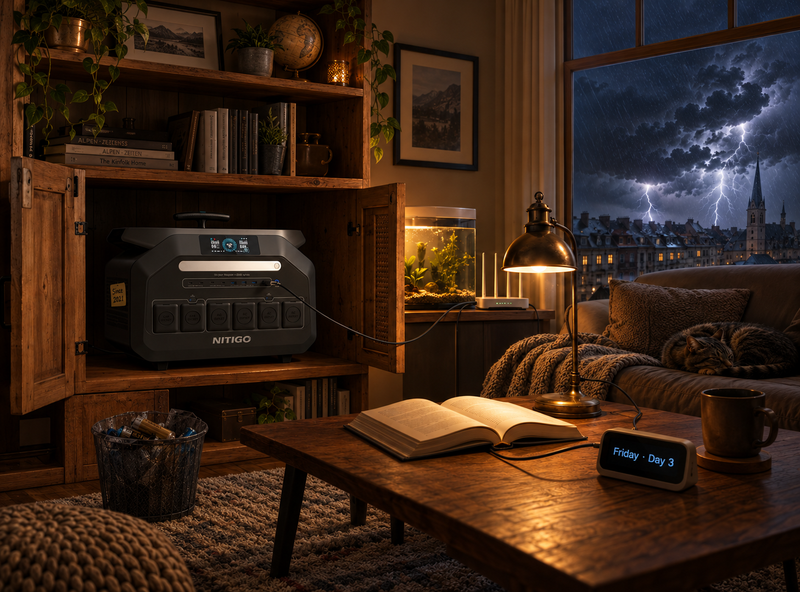





A power outage does not affect a household in the same way: the light goes out, the router loses its connection and a heating control system can stop working even though the actual heating still has fuel. An emergency power battery should therefore first supply communication, safe lighting and individually necessary devices. Consumers with high heating output, on the other hand, usually remain switched off, so that the stored energy lasts longer for basic needs.
A good priority list doesn't come from wattage alone. In addition to the continuous power, short start-up peaks, the desired operating time, the connection of the device and the permitted use of the power station also count. If you check these points before the failure, you can use the reserve in a targeted manner. The first step is to rank all consumers according to importance and technical suitability.
Which devices can an emergency power battery supply in the event of a power outage?
An emergency power battery can supply individual devices, whose combined continuous and starting power remains within its initial limits. Priority is given to small, important consumers; Strong heating devices and permanently connected building services are only planned after a separate check.
Prioritize refrigerator, router, lights and communications
This Federal Office for Civil Protection and Disaster Relief Recommends, among other things, charged communication devices, alternative lighting and a battery-operated radio for power outages. A practical sequence for battery emergency power can be derived from this:
- Secure communication: Only plan a router, fiber optic modem or telephone base if the upstream network is still working. Smartphones and a radio remain additional sources of information.
- Provide safe lighting: A few LED lights use significantly less energy than full room lighting.
- Consider personally necessary devices: This can include aids whose operation and power source have been previously agreed with the manufacturer or specialist personnel.
- Maintain cooling temporarily: Check the nameplate and starting power, keep doors closed if possible and only continue the supply for as long as necessary.
This order is not a rigid pattern. Medications, care needs, children or winter temperatures can change priorities. What is crucial is that to reserve individually indispensable devices ahead of comfort consumers.

Operating the heater with emergency power in the event of a power failure: What needs to be checked?
A heater can only be planned sensibly if its controls, pumps and ignition are electrically suitable and safely accessible. An electric fan heater, on the other hand, requires so much power and energy that that it usually discharges a mobile storage device very quickly. When considering alternative heating sources, the BBK recommends seeking professional advice and the necessary safety precautions.
| Consumer | Check before connection | Priority |
|---|---|---|
| Heating control and circulation pump | Plug or permanent connection, nominal and starting power, manufacturer approval | High if heat supply depends on it |
| Water or sewage pump | Starting current, dry running protection, required operating time | Depending on the situation |
| Electric fan heater | Very high continuous load and short computational runtime | Mostly low |
| Kettle or hot plate | High performance, If possible, use them individually and only for a short time | Comfort or short-term use |
How are performance and required capacity calculated?
Two limits must be calculated separately for the selection: watts determine which devices can run at the same time, and watt-hours determine the possible runtime. Both values must match, otherwise the station is either immediately overloaded or empty earlier than planned.
Distinguish between continuous power and starting current
First, add up the power ratings of all devices that will be on at the same time. Motors, compressors and pumps can demand significantly more when starting than during operation. The peak performance of a power station is relevant However, it does not replace a test of the permissible continuous load.
A reliable load plan is created four Steps:
- Record the rated power of each consumer on the nameplate or in the manual.
- Only add up the devices that are actually running at the same time.
- For motors and pumps, add the starting power from the device data.
- Leave a reserve for unknown load changes and separate high consumers in time.
A combination of inverter, battery and emergency power output is only as resilient as their weakest link. Cables, power strips and individual outputs also have their own limits that are not canceled by a high battery capacity.
Calculate runtime with efficiency and reserve
The theoretical runtime results from usable energy divided by the connected power. Ours NITIGO FAQ uses the factor 0.85 for an initial AC estimate: battery capacity in Wh times 0.85, then divided by the load in W. Self-consumption, temperature, state of charge and changing loads can shorten the real runtime.
Example of a constant AC load of 100W with a fully charged battery:
| Capacity | Can be used mathematically with a factor of 0.85 | Estimated runtime at 100W |
|---|---|---|
| 1,024 Wh | about 870 Wh | about 8.7 hours |
| 2,048 Wh | about 1,740 Wh | about 17.4 hours |
Additionally, plan a reserve, instead of planning the battery down to the last watt hour. This preserves energy for an unexpectedly important device and leaves room for peak loads.
How to safely use a power station at home?
The safest way is for a mobile power station to supply individual, suitable devices directly via their intended outputs. It is dry, stable and freely ventilated; Cables are routed in such a way that they are neither crushed nor a tripping hazard.
Connect devices directly or via a suitable extension
Before switching on, a quick safety check will help:
- Check the power station, cable and plug for visible damage, moisture and unusual heating.
- Only use undamaged extensions with sufficient load capacity and unwind cable drums according to the manufacturer's instructions.
- Keep ventilation openings clear and observe the permissible operating and storage temperatures of the model.
- Do not load multiple sockets beyond their rated capacity; the BBK warns of overheating if overloaded.
- Avoid wet rooms, rain and heat sources unless the manual expressly permits such operation.
No impermissible feedback into the socket or house network
A power station may not feed back into a house socket with a cable that can be plugged in on both sides. Cables can unexpectedly become live, protective devices work incorrectly and emergency services or other people are endangered.
If a fixed heating system or a selected circuit is to be supplied, an approved system with safe mains isolation and professional installation are required. The BBK guide to power failures recommends planning the scope and performance of an emergency power system with a recognized electrical specialist. Homemade feedback cables are not a permissible shortcut.
When is EPS enough and when is a real UPS necessary?
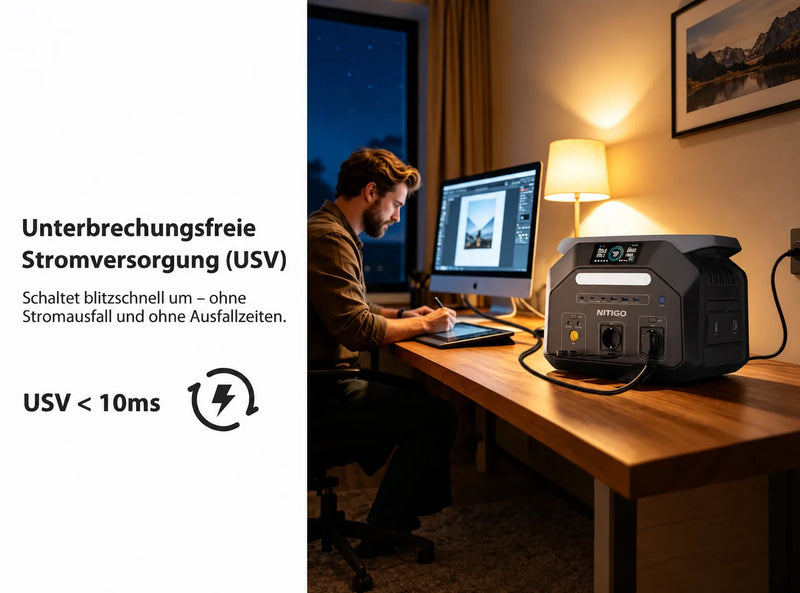
A short interrupt switching function can be sufficient for routers, chargers or many computer power supplies, However, it is not automatically suitable for every sensitive device. If just a few milliseconds can lead to data loss, malfunction or a safety risk, an appropriately classified UPS must be selected based on the consumer's requirements.
Switchover time and possible short interruption

NITIGO specifies a switching time of up to 10 ms for the P1800 and P2400. This value describes the transition from mains to battery operation, not a universal compatibility guarantee. Whether a device tolerates the short gap depends on its power supply, its settings and the manufacturer's specifications. A controlled test run can test the specific combination, but must not replace a safety-critical manufacturer approval.
Servers, medical and particularly sensitive devices
For servers and other critical IT systems, requirements for power quality, redundancy and controlled shutdown can go beyond a simple switchover time. The DIN EN IEC 62040-3 describes performance and testing requirements for UPS systems. For medical or safety-critical devices, it must be clarified in advance based on the manufacturer's information or with medical specialists whether the power station is suitable as a power source. A power station does not replace a mandatory medical emergency power solution.
Which NITIGO model fits the backup plan?
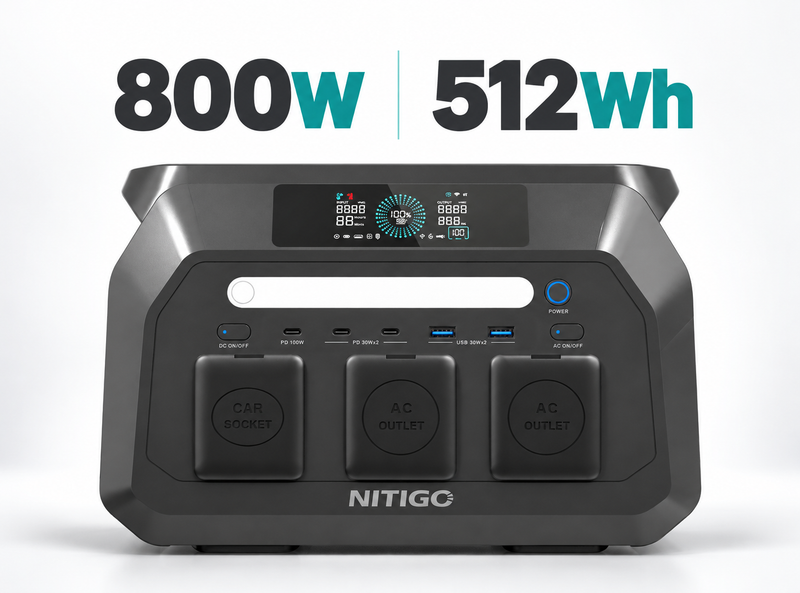
The choice of model follows from the previously calculated simultaneous load and the desired runtime. Our P1800 offers more mobility and a smaller power reserve, while our P2400 doubles the capacity. The permissible AC continuous power must be the same as the current one for both devices Manual of the offered Model version can be compared.
P1800 for centralized equipment and shorter outages
Our P1800 combines 1,800 W continuous power with 1,024 Wh capacity. It is suitable for a prioritized plan of lighting, communication, laptop and other technically suitable individual devices, as long as the total and starting power remain within the limits. Delayed switching on makes sense, especially if there are several strong consumers.
P2400 for longer runtime and multiple consumers
Our P2400 has 2,048 Wh capacity. At the same constant load, it offers roughly twice the runtime of the P1800. Before connecting several devices, the permissible AC continuous power of the specific version offered must be checked in the associated manual; The larger energy reserve does not replace this control or the testing of starting currents.
| model | Continuous performance | Capacity | Meaningful classification |
|---|---|---|---|
| NITIGO P1800 | 1,800W | 1,024 Wh | Central devices, shorter outages, lower energy requirements |
| NITIGO P2400 | 2,400W | 2,048 Wh | Longer bridging; Compare simultaneous load based on model |
How does the power station stay ready for use?
An emergency power battery only helps if the charging status, cables and consumers were checked before the failure. A short, scheduled test run shows whether the intended load starts and whether all the required adapters are actually present.
Check the charge level regularly and carry out a test run
Set a fixed inspection date, for example together with smoke detector or inventory checks. Document the charging status, error messages and the runtime of a representative consumer. Our NITIGO FAQ recommends a full charge and discharge cycle approximately every three months for long-term storage; The manual for the specific model always applies to the exact procedure.
An emergency power battery with solar can be recharged when there is enough sun if the voltage, current, connection and maximum solar output match the input of the power station. However, solar energy does not necessarily extend the available reserve: weather, shading and ongoing consumption determine whether the battery level actually increases.
Store in a dry, ventilated and temperature-protected place
Backup batteries belong in a dry, well-ventilated place within the specified storage temperature. Avoid direct sun, radiators, moisture and mechanical stress. Damaged cases, deformed battery areas, unusual smell, or repeated temperature shutdowns are reasons not to continue using the station and contact support.
Next step: Make a list of the device, wattage, starting power and desired runtime. Then compare P1800 and P2400 based on the calculated load, required energy reserve and connections. In the case of a permanently integrated house or heating supply, an electrical contractor must plan the permissible solution.
Frequently asked questions
Q1: Can a backup battery power a refrigerator during a power outage?
Yes, if the continuous and starting power of the device matches the power station. For more realistic runtime planning, measure energy consumption over 24 hours during normal operation if possible, because the compressor only runs intermittently. Room temperature, filling level and door openings change this daily value; The short starting peak must still match the peak power of the station separately.
Q2: Can a power station be connected directly to the house network?
Not via a normal socket or a cable that can be plugged into both sides. Even a simple adapter does not allow feedback. When interfering with the electrical installation of a rented apartment, the tenancy law requirements and any necessary consent from the landlord must also be clarified. Planning and execution belong in the hands of a specialist electrical company.
Q3: Can the power station remain permanently connected to power?
Only if the manual for the specific model version allows the intended through-loading or EPS operation. Ventilation, temperature, maximum bypass load and regular functional tests remain important. For long absences, the storage instructions in the manual apply instead of a general recommendation for permanent connection.
Q4: What does the switching time mean for EPS or UPS?
It refers to the time between power failure and supply from the battery. Some device manuals specify a permissible power supply backup or hold time; this value can be compared with the station's 10 ms. If a controlled test shows a reboot, an error message or a disconnection, a UPS with backup time and output quality that meets the requirements of this device is required.
Q5: What warning signs require immediate shutdown?
Strong unusual odors, smoke, sparks, deformation, fluid leaks, unusual heat, or repeated protective shutdowns are clear warning signs. Only disconnect the device if it is safe to do so, keep your distance and stop using it. In the event of smoke or fire, call emergency services; For a technical check, please contact our online support.