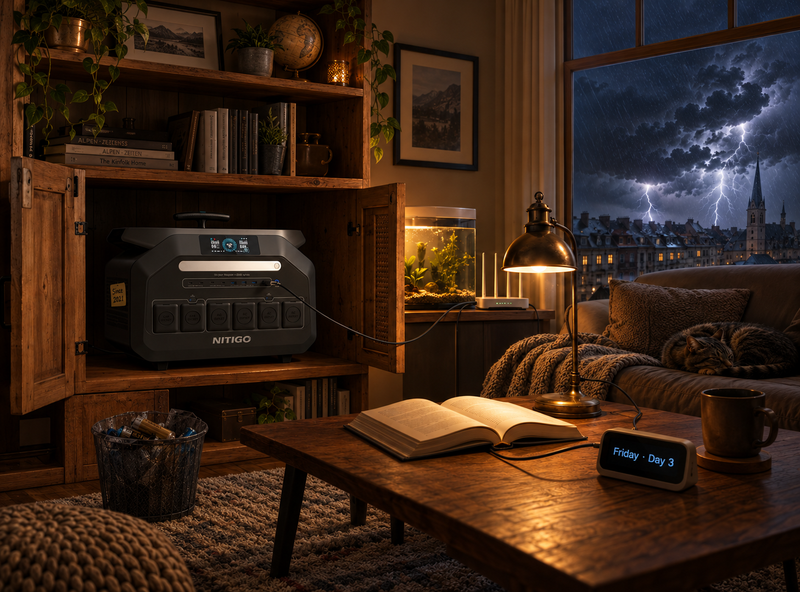


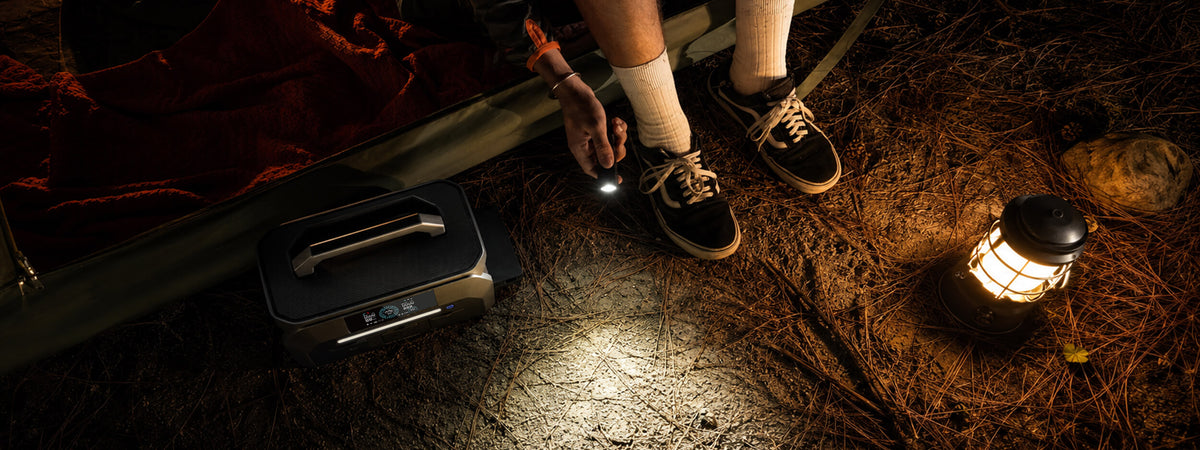
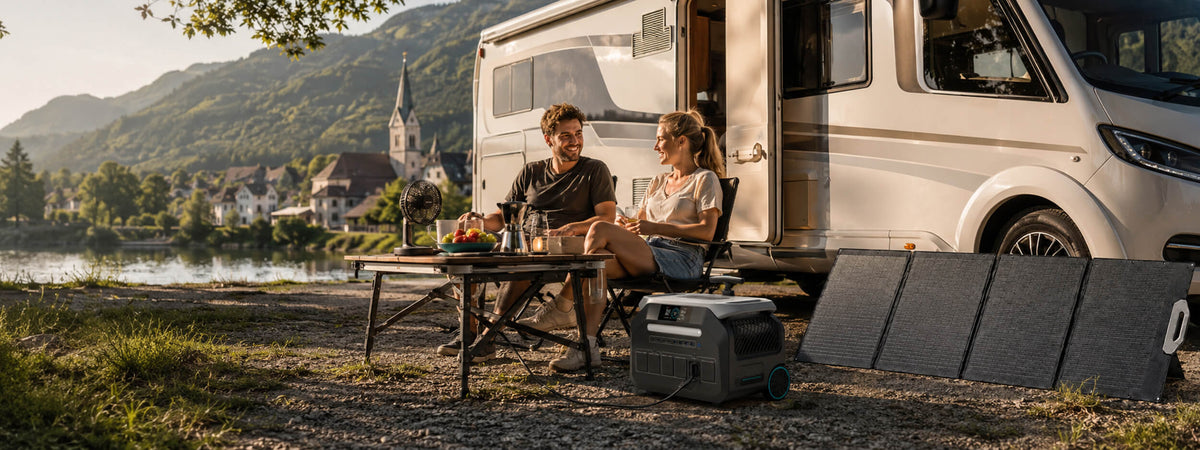
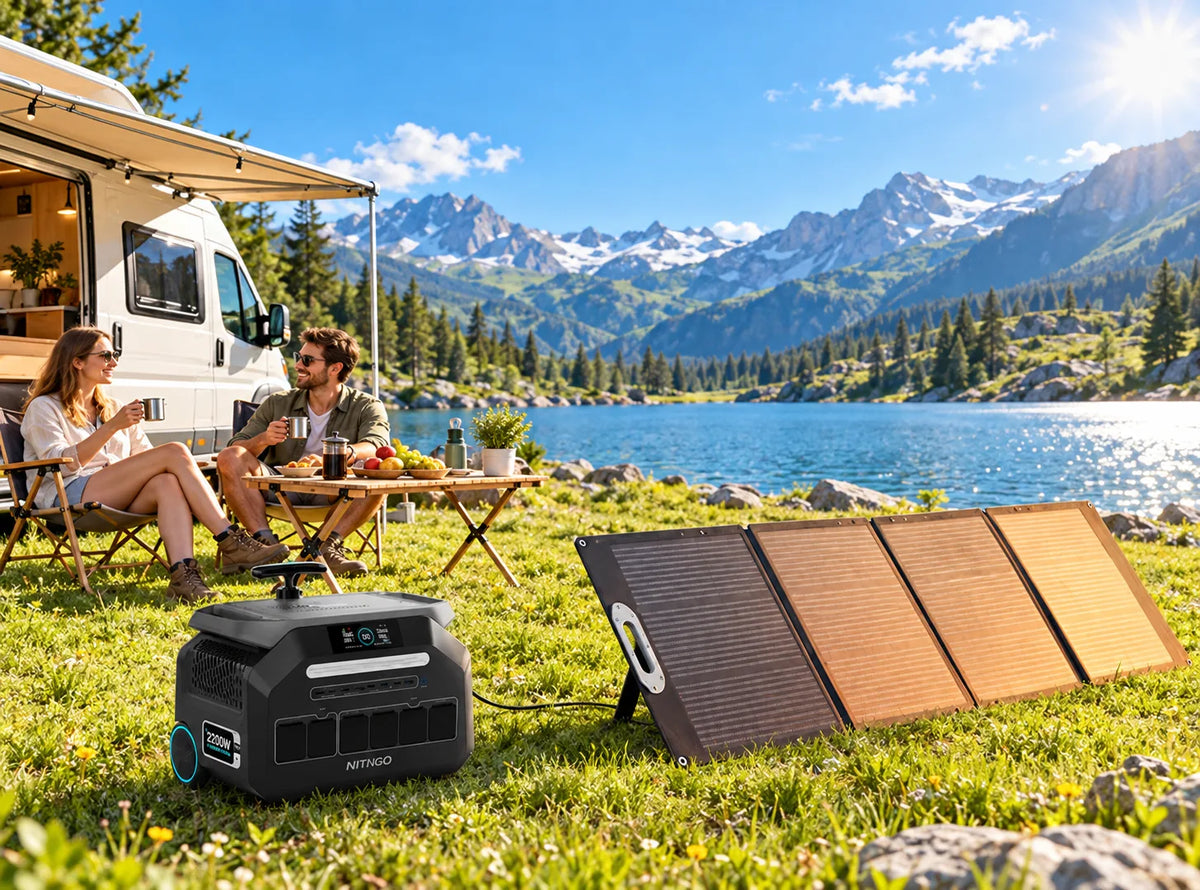
On a weekend trip, the cooler stays cold, while smartphones, lamps and the occasional laptop need power. A smaller power station is usually sufficient for this profile; For longer stays, a coffee machine or several devices running at the same time, more power and capacity makes sense. This results in the right size not from the size of the vehicle, but from your highest simultaneous power requirement and energy consumption per day.
A large camping power station creates reserves, but takes up more storage space. A light model travels more comfortably, but can run out of battery power sooner without the possibility of recharging. Therefore, create a device list before comparing models and convert each consumption into watt hours.
How much electricity do you need when camping?
Your electricity requirement is the sum of the energy that all devices use within a day. Not only the wattage information is important, but also the runtime, charging frequency and connection type. For initial planning, a nameplate, power supply and a realistic useful life are sufficient.
Capture cool box, lighting, smartphone and laptop
Record performance and active time per day for each regularly used device. The calculation is: watt times hours equals watt-hours. For a smartphone or camera, the energy per complete charge is sufficient.
The example calculation below shows the method, not the guaranteed consumption of your equipment. A compressor cooler doesn't run constantly depending on the temperature and thermostat; For longer trips, measure a typical day if possible.
| device | Example assumption | Daily energy |
|---|---|---|
| Compressor cool box | 45W x 8h active runtime | 360 Wh |
| LED lighting | 10W x 4H | 40 Wh |
| Two smartphones | 15 Wh each x 1 charge | 30 Wh |
| Laptop | 65W x 2H | 130 Wh |
| Total | 560 Wh per day |
A power station for the cool box alone would have to be smaller than a system for the entire daily requirement. USB-C or a suitable 12 V output can also be more efficient than the detour via 230 V, provided the device and output match.
Calculate cooking appliances, pumps and other short-term consumers separately
Coffee machines, kettles or pumps often only run for a few minutes, but require high performance during this time. Therefore, separate energy and performance: Ten minutes with 1,000 W corresponds to around 167 Wh, but the power station must still be able to deliver the full 1,000 W during operation.
For heavy consumers, proceed in this order:
- Record the nominal power and possible starting power in the device manual.
- Check which devices should really run at the same time.
- Convert runtime into hours and calculate consumption in Wh.
- Avoid unnecessary parallel use, such as using the kettle and coffee machine one after the other.
How much power and capacity do you need?
The continuous output must cover all devices running at the same time, and the capacity must cover the planned energy requirements. Watts and watt hours must not be interchanged. A 2,000 W power station can carry a high load, but does not automatically run for a long time with a small battery.
Consider simultaneous consumers and possible starting power
Add up the watt values of devices that are active at the same time. Compressors, pumps and motors can briefly require more power when starting. The device specifications as well as the continuous and peak performance of the power station are decisive.
Calculate daily consumption, travel duration and realistic energy losses
Multiply the daily requirement by the days without safe recharging and add a reserve. The actual usable energy is below the nominal capacity because inverters, electronics and conversion themselves require electricity. The ADAC explains this difference between nominal value and usable capacity in its Powerstation test.
For reliable planning you can calculate as follows:
- Sum up the daily consumption of all devices in Wh.
- Multiply by the number of days without grid, vehicle or solar charging.
- Provide a reserve for losses, cold, aging and unplanned use.
- Compare the result with the usable energy under your specific connection type.
Once you have determined daily consumption, simultaneous load and available recharging options, you can better narrow down the appropriate power range. They are available for the following camping comparison NITIGO models P800, P1800 and P2400 in the center. They have different priorities when it comes to mobility, capacity and output power.
Which camping trips is the NITIGO P800 suitable for?
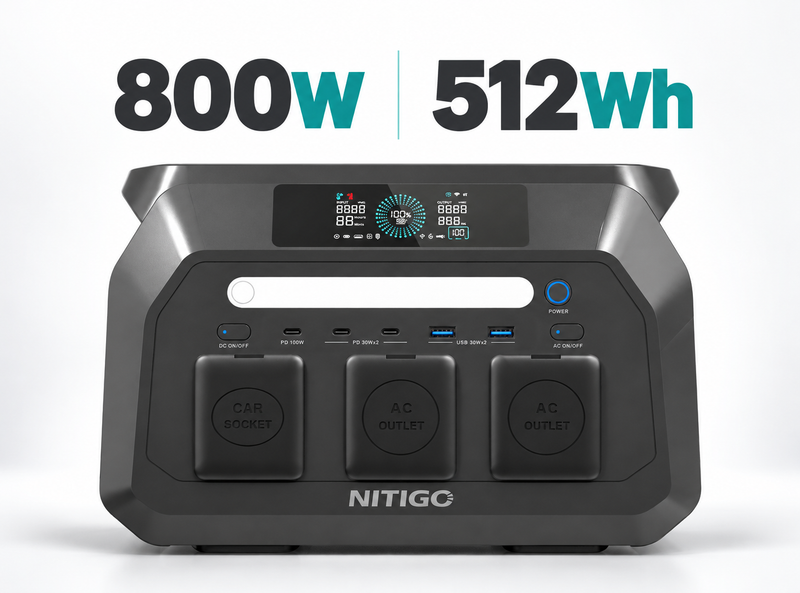
If mobility is what counts most on your trip and only a few devices need to be supplied, the P800 a compact entry. With 512 Wh capacity and 800 W continuous power, it is particularly suitable for short trips, manageable loads and limited periods without a mains connection.

Organize short trips and manageable equipment requirements
Typical tasks include charging smartphones, cameras and laptops, LED lights or a suitable cool box. Your bill will show whether 512 Wh is enough for one night. In the example with a daily requirement of 560 Wh, the full supply without recharging would be too tight due to additional losses.
Trade off lower weight against limited capacity and performance
At 6.5 kg, the P800 can be carried to the tent, picnic area or vehicle more often. This mobility advantage is particularly valuable if you change locations every day. However, for powerful cooking devices or for several days without recharging, 800 W and 512 Wh significantly limit the use.
When is the NITIGO P1800 the more suitable choice?
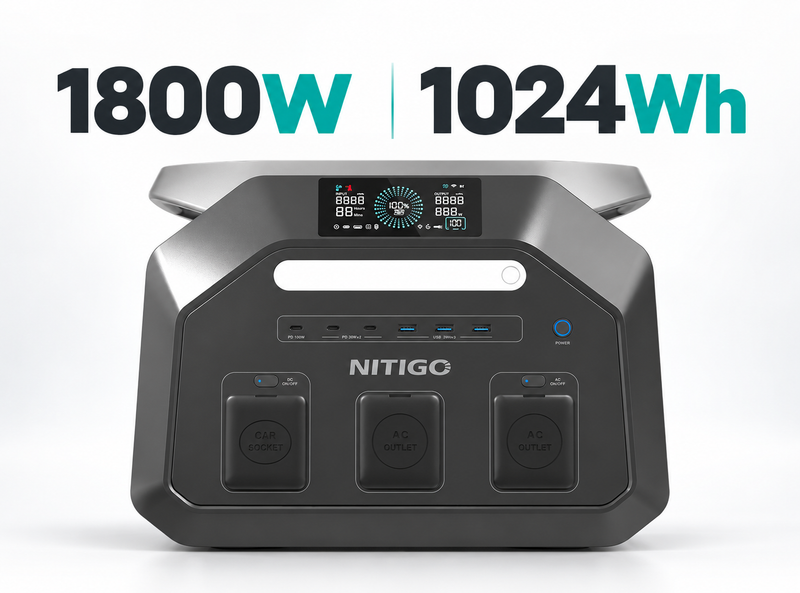
If the performance or capacity of the P800 is not sufficient for your device list, it offers P1800 the next sensible step. It combines a larger energy reserve with sufficient power for several everyday devices and many more powerful individual appliances. It offers 1,024 Wh capacity and 1,800 W continuous power, creating more scope than the P800.

Combine cool box, laptop and more powerful individual devices
A cooler can continue to run while the laptop or camera is charging, as long as the total load remains within the output limits. Many coffee machines also fall into this class rather than the P800. However, check the performance and startup behavior of each device.
Balance medium energy requirements and transport costs
The P800's double rated capacity extends the possible supply, but does not replace a consumption bill. The P1800 is noticeably heavier and takes up more space. It's a good fit if it stays mostly in the vehicle but needs to be able to move around when it's parked.
Who is the NITIGO P2400 useful for when camping?
If the downtime is longer or there is a significantly higher energy requirement, it moves forward P2400 in the center. Of the three models compared, it offers the greatest performance and capacity reserve, but also requires more transport and storage space.

Consider longer stays and multiple consumers
Consumption grows quickly during family trips, mobile working or frequent cooking. The P2400 can cover more loads at the same time, but even 2,048 Wh is finite for heaters, kettles or permanent 230 V use.
Balance higher energy reserves against weight and space requirements
The higher capacity is particularly worthwhile if a fixed storage space is planned and does not have to be carried every day. However, it would be unnecessarily complicated for hikes from the parking lot to the tent.
Finally, how do the P800, P1800 and P2400 compare?
The following applies to the power station comparison when camping: P800 prioritizes mobility, P1800 balances reserve and transport, P2400 prioritizes runtime and high simultaneous load. The best size is the smallest model that covers your continuous and starting power and, after losses, has enough energy until the next reliable charge.
Compare capacity, continuous power and weight
The currently published core values clearly classify the three classes. The transport assessment is deliberately formulated in a practical manner; Check dimensions, outputs and model-related limits in the manuals before traveling.
| model | Capacity | Continuous performance | Transportation | Matching profile |
|---|---|---|---|---|
| NITIGO P800 | 512 Wh | 800W | 6.5kg, frequently portable | Short trip, basic equipment |
| NITIGO P1800 | 1,024 Wh | 1,800W | 12.7kg | multiple devices, medium service life |
| NITIGO P2400 | 2,048 Wh | 2,400W | 24kg | long service life, high load |
You can find the model-related data and connection limits in our NITIGO user manuals. The also provides an overview of our current energy solutions NITIGO homepage.
Plan grid, vehicle and solar charging for your travel route
A power station with a solar panel for camping can extend service life, but does not guarantee a fixed daily amount. Weather, orientation, shade and allowable solar input determine yield. The ADAC shows this in its guide Solar system in the camper, why consumption and solar output should be planned together.
Assign your route to a reloading strategy before departure:
- Campsite with shore power: Use mains charging as a predictable main source.
- Frequent trips: Only use vehicle charging within the approved entrance limits.
- Several sunny days at the pitch: Choose a compatible solar panel that matches the voltage, current, plug and maximum solar power.
- Uncertain weather: Choose capacity like thisthat a weak solar day does not immediately lead to the failure of important devices.
Select P800, P1800 or P2400 specifically
Make the pre-selection based on device requirements, travel duration, transport and recharging options:
| When the most important thing for your trip is | Preselection | Check before deciding |
|---|---|---|
| little luggage and basic equipment | P800 | 800 W and 512 Wh are enough |
| versatile use with medium service life | P1800 | 1,800 W and 1,024 Wh cover the profile |
| high load or a long period of time without a secure charge | P2400 | 2,400 W and 2,048 Wh plus transport space fit |
Then check the current connections and charging limits so that the model fits your camping trip.
Frequently asked questions
Can a power station be operated in a tent or motorhome?
Yes, provided the location is dry, stable and well ventilated and the operating instructions allow its use. Do not cover ventilation openings, keep away from combustible materials and do not operate the device in a damp sleeping area or in direct sunlight.
How is a power station secured during transport in the vehicle?
Secure the power station so that it cannot slip or tip over when braking or cornering. Place it on a firm surface and protect connections and cables from pressure and shock. The DGUV recommends protected transport for lithium-ion batteries and avoiding mechanical stress.
How can a power station be protected from moisture on the campsite?
Place it elevated on a dry, solid surface and protect the device, cables and open connections from rain, condensation and wet floors. An awning does not replace designated weather protection. If the station has become damp, disconnect it from consumers and charging sources and only put it back into operation after checking it according to the manual.
Can a power station be charged via the shore power connection?
Yes, via the designated mains charging cable and proper campsite supplies. Do not use improvised adapters or damaged extensions. Please note the site rules, the protection of the connection and the permissible AC input power of your model version.
How should the power station be stored between two camping trips?
Store the station switched off, dry, frost-free and protected from direct sun. Avoid both complete discharge and unattended continuous charging and check the charging status at the intervals specified in the manual. If the device is deformed, unusually warm, has an odor or the housing is damaged, do not continue to use it.