



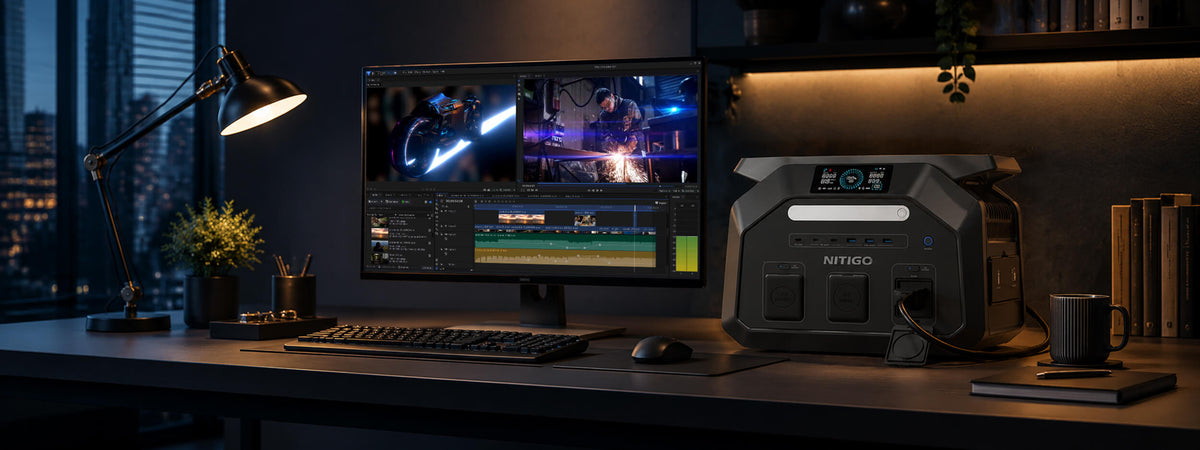
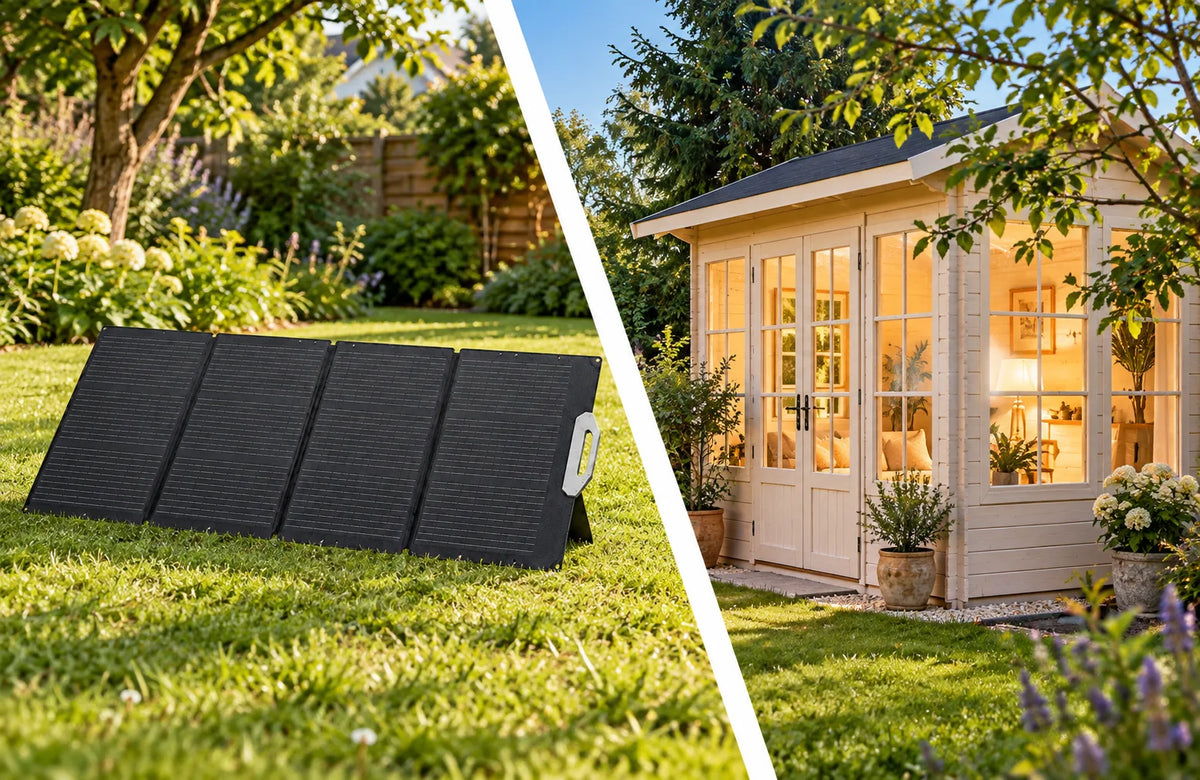
At a campsite, the motorhome is in the shade, while a few meters away there is an open area in the sun. A mobile solar panel can be aligned there and can recharge a compatible power station without reparking the vehicle. At home, the same panel charges in the garden or on the balcony, as long as it is secure and does not feed into the home network without suitable technology.
However, how much energy actually reaches the battery is determined by the interaction of light, orientation, temperature and electrical input. A high nominal power is of little help if a branch shades parts of the cells or voltage and current do not match the power station. Therefore, start with the location and daily energy requirements before selecting power, charging time and combination.
What applications is a mobile solar panel suitable for?
A mobile solar panel is suitable for temporary, flexible power generation, if there is enough sun and a suitable power station or charging electronics at the place of use. It does not replace a permanently attached roof system nor does it automatically replace an approved plug-in solar device for feeding into the grid.
Power supply when camping and traveling
When camping, the panel can supply energy during the day, while the cool box, smartphone, camera or light discharge the battery. A foldable camping solar panel can be rotated towards the sun independently of the vehicle. The ADAC names foldable solar cases as a flexible solution, especially for tents, roof tents and tent caravans, and emphasizes that the module size and storage must match the consumption. Further basics are provided by the ADAC guide for campers.
These application profiles are particularly useful when traveling:
- Pitch with free sunbathing area next to a shaded tent or vehicle.
- Road trip with power station, cool box and daily charging needs for mobile devices.
- Day trip, photography or gardening without an accessible socket.
- Emergency reserve for recharging selected devices, not as a guaranteed full supply.
Flexible solar energy for balconies, gardens and homes
On the balcony, terrace or in the garden, a portable solar panel can charge a power station that later supplies individual devices. Secure the panel against wind and observe rental, building and location regulations when it is to be secured. A connection to the home network, on the other hand, requires an overall system designed for this purpose; the consumer advice center explains the requirements for a Plug-in solar device.

| Location | Meaningful purpose | Important border |
|---|---|---|
| Campsite | Recharge the power station during the day | Plan for shade and theft protection |
| Balcony or terrace | Load mobile storage | Safe installation, no improvised grid feed |
| Garden or home | Power individual devices via memory | Protect panel and station from moisture |
| On the way | Complement communication and camera energy | Pay attention to weight, pack size and sun windows |
How much electricity does a mobile solar panel generate in practice?
The real yield is usually below the calculated maximum of nominal output and hours of sunshine. For planning purposes, the energy generated during the day in watt hours counts, not the highest briefly displayed watt value.
Differentiate between nominal power and actual output power
The nominal power is determined under specified test conditions. A 200W panel could mathematically deliver 200Wh in an hour if it achieves the output consistently. In practice, irradiation, cell temperature, angle and state of charge change, so that the input power fluctuates.
Therefore, measure several times and also record the daily energy, if the display shows it. A single midday measurement cannot be used to determine the winter yield or a fixed charging time.
Influence of sun, shade, temperature and season
Direct light and a favorable angle of incidence increase the yield. Partial shading can significantly reduce it, while high cell temperatures reduce efficiency. In winter there are shorter days, a lower position of the sun and more frequent diffuse radiation.
The most important influences and countermeasures can be arranged as follows:
| Influence | Typical effect | Practical response |
|---|---|---|
| position of the sun | Performance changes throughout the day | Readjust the panel if it is not in use for a longer period of time |
| Partial shading | Individual cells limit the yield | Also avoid small shaded areas |
| High temperature | Cell performance may decrease | Allow air circulation behind the panel |
| Winter | Shorter usable solar window | Plan more reserve and longer charging time |
You can also find information on the connection between alignment, inclination and shading at ADAC for PV alignment.
Is the mobile solar panel compatible with my power station?
Yes, if the panel's output values and connections are within the permissible input limits of your exact power station. The same wattage or a mechanically suitable plug are not sufficient proof.
Check input voltage, input current and solar power
Compare the panel's open-circuit voltage to the station's allowable voltage window. Operating current and possible short-circuit values must not exceed the intended limits. The maximum solar power also shows how much power the input can handle; a larger generator does not remove voltage and current limits.
Use this order for the comparison:
- Capture panel data for open circuit voltage, operating current and rated power.
- Check the voltage range, maximum input current and solar power of the model version.
- Completely calculate the planned series or parallel connection.
- If there is conflicting information, consult the current manual or support before connecting.
Assign plugs, adapters and polarity correctly
Plugs and adapters must fit mechanically and electrically. Check the plus-minus assignment on both sides, as an adapter can change the assignment. Connect or disconnect the system according to the device instructions and do not pull on the cable.
How long does it take to charge a power station with solar energy?
A reliable charging time results from the remaining battery capacity and the average solar power available. The calculation provides a planning range, not a guarantee, because performance and charging behavior vary throughout the day.
Calculate charging time from battery capacity and actual input power
Divide the watt-hours to be recharged by the average input power. For example, if 600 Wh is missing and there is an average of 120 W across the solar window, the ideal calculation is five hours. Charging losses and a possible reduction in performance when the battery level is high extend the time.
Calculate the margin step by step:
- Determine missing energy from battery capacity and charge status.
- Use realistic average solar power instead of nominal power.
- Calculate bottom time: missing reps divided by average reps.
- Add reserve for losses, clouds and tracking.
Plan realistically for weather and conversion losses
Clouds can change the input power within a short period of time. Cables, charge controllers and batteries cause further losses, while devices being operated at the same time directly consume some of the solar energy. Therefore, do not plan with a single ideal value, but rather with a favorable and a cautious variant.
How is a mobile solar panel set up correctly and safely?
Place the panel in a stable position, with as little shadow as possible and with a clear back. The surface must be able to absorb wind loads; cables must neither become a tripping hazard nor lie under doors or wheels.
Optimize alignment, tilt angle and shadows
Align the module surface as perpendicular as possible to the sun and adjust the angle for longer periods of use. Watch not only trees, but also awnings, roof edges, antennas and people whose shadows may later move across the panel.
Protect panel and cable from wind, moisture and damage
Use the supports and attachment points provided without tensioning cells or folding areas. Keep connectors dry and clean, do not place them on wet ground and check cables for crushing before each use. The protection class of a panel does not automatically apply to adapters, connectors or the power station.
Which NITIGO combination suits the planned use?
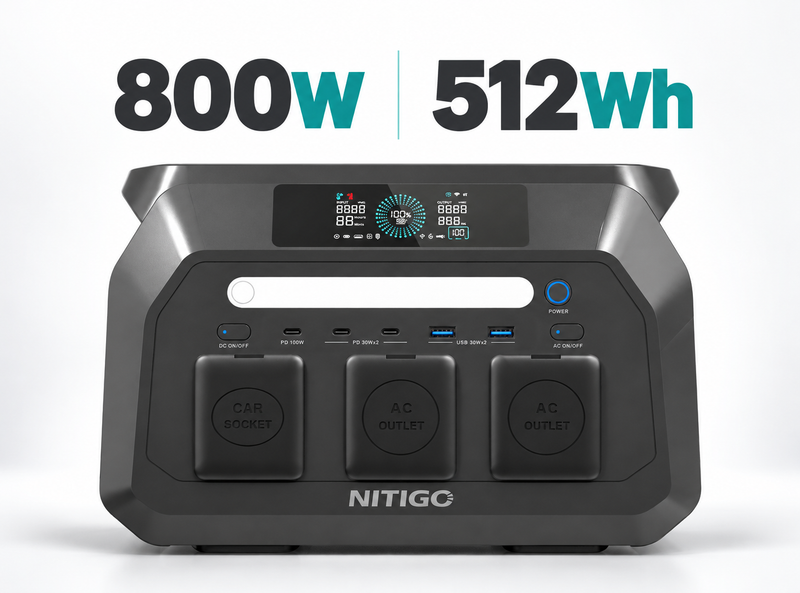
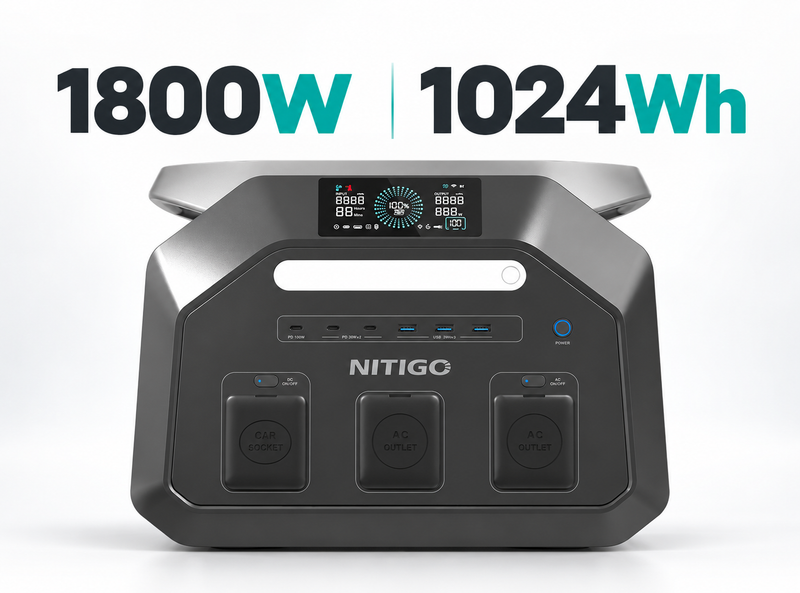
Our current range includes three solar set configurations: P1800 + SP200, P2400 + SP200 and P3200 + 2 x SP200. Which combination best suits your application depends on your daily energy needs, the desired energy reserve, the available solar window and the space for the solar panels.
Which NITIGO solar sets are available?
The P1800 and P2400 are each combined with a foldable SP200. The P3200 solar set contains two SP200s, providing a total of 400 W rated panel power.

| NITIGO solar set | Panel configuration | Common power rating | Practical classification |
|---|---|---|---|
| P1800 + SP200 | 1xSP200 | 200W | For camping trips and moderate energy requirements |
| P2400 + SP200 | 1xSP200 | 200W | For larger storage requirements, whereby a longer solar window must be planned for recharging |
| P3200 + 2 x SP200 | 2 x SP200 | 400W | For high energy requirements and longer service lives with sufficient space |
A single SP200 is easier to transport and requires less space to set up. Two SP200s can increase the possible solar output, but must be connected according to the current user manual. The decisive factors are the permissible input voltage, the maximum input current and the enabled wiring of the respective power station.
You can find the exact connection and input limits in our NITIGO user manuals. Additional information about solar charging and simultaneous charging and discharging is available in the NITIGO FAQs.
Select a solar solution based on mobility, energy requirements and charging time
For frequent changes of location, a panel that is easy to carry and can be set up quickly is important. With longer stays, it becomes more important how many watt hours need to be recharged each day. A power station with a solar panel when camping should therefore be planned as an overall system, not as two separate products.
Select a suitable mobile solar panel
First compare the daily energy requirements, then the realistic solar output at the location and finally the electrical limits. This way you can see whether a single foldable solar panel is sufficient or whether a larger, expressly approved combination makes sense. Before making a decision, check the packing size, cable route and manual so that the mobile solar panel can be used reliably at home and on the go.
Frequently asked questions
Does a mobile solar panel also work in winter?
Yes, with enough light it generates electricity even in winter. Additionally, please note that the open-circuit voltage of solar modules can increase in cold weather. Especially with several panels connected in series, the temperature-dependent total value must remain below the permissible input voltage.
Can a solar panel be used behind a window pane?
A charge may be technically possible, but it is often significantly weaker. Multiple glazing, coatings, reflections and an awkward angle reduce usable light; In addition, the panel behind glass can heat up. A safe outdoor installation is usually cheaper for the yield.
Can two mobile solar panels be connected to each other?
Only if the power station, panels, cables and manufacturer approval support the selected circuit. In series the voltages increase, in parallel the currents add up. Calculate both values including open circuit voltage and stay below all input limits.
Can a foldable solar panel be left permanently in the rain?
No, a protection class like IP67 is not a license for permanent outdoor installation. With the SP200 it refers to the panel, not automatically to open MC4 connections, adapters or the power station. After mobile use, dry and store the system according to the instructions.
Can the power station supply devices while solar charging?
Yes, our NITIGO portable power stations support simultaneous charging and discharging. However, the consumer load increases the net charging time or can lower the battery level despite the sun. Also note the separate input and output limits in the current manual.