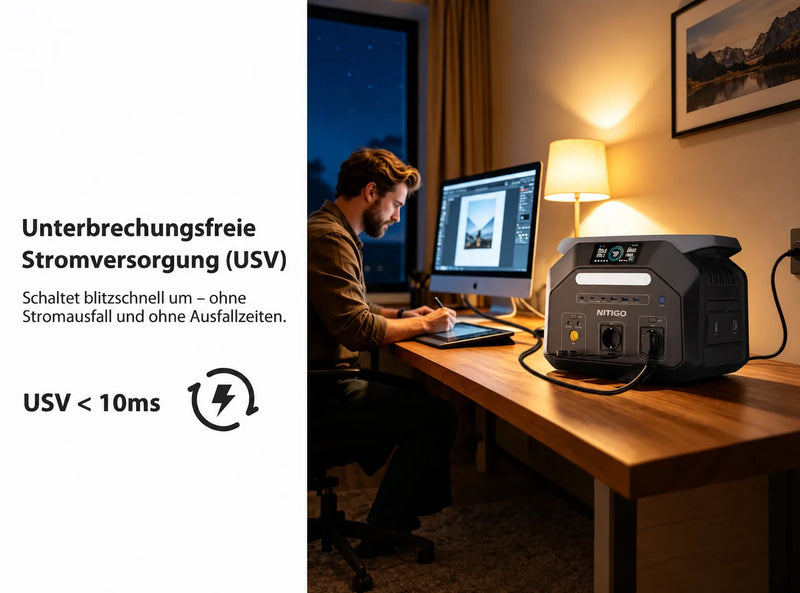


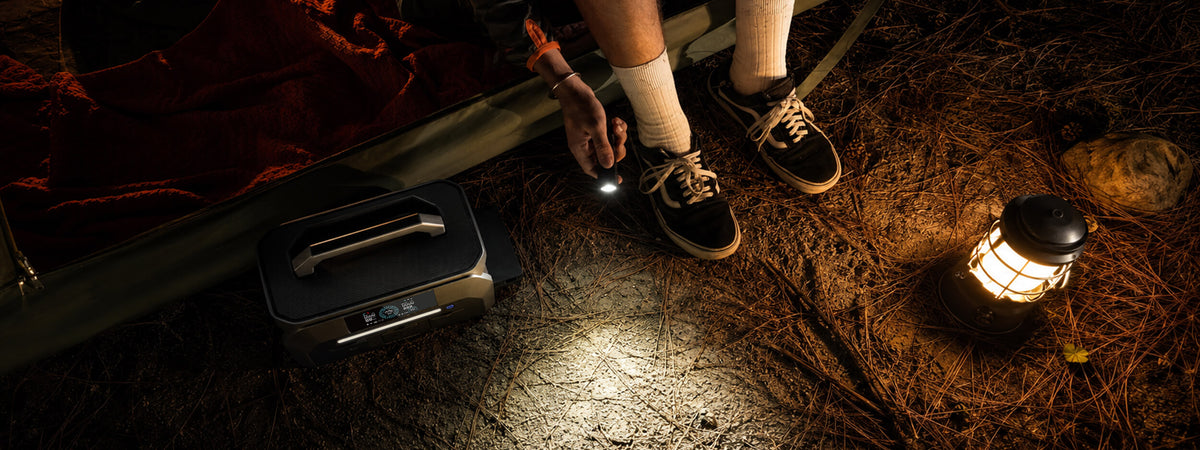
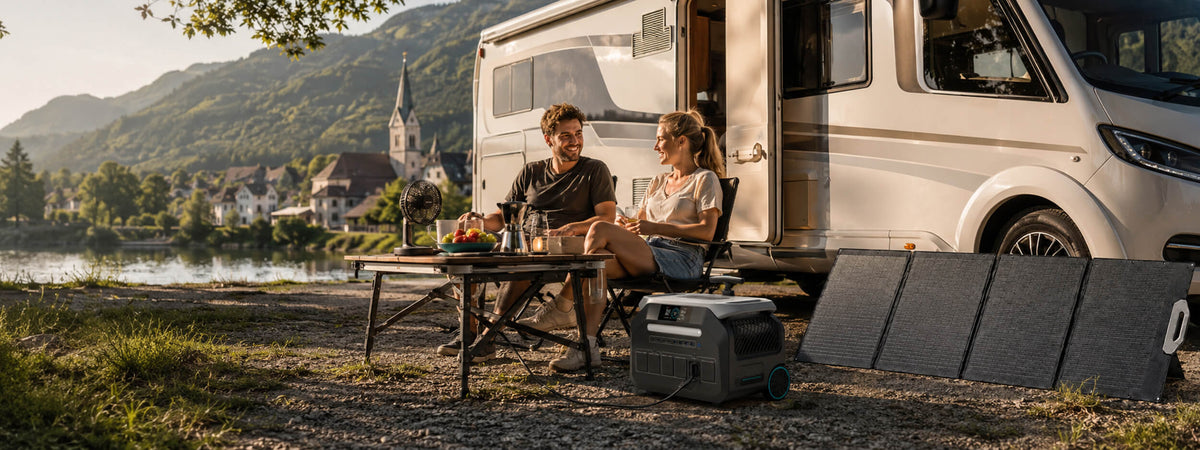
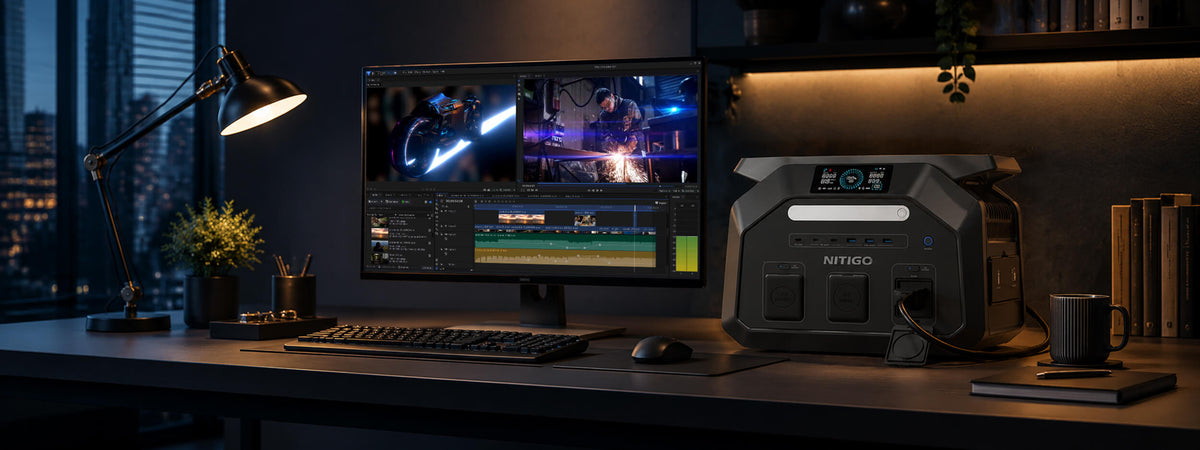
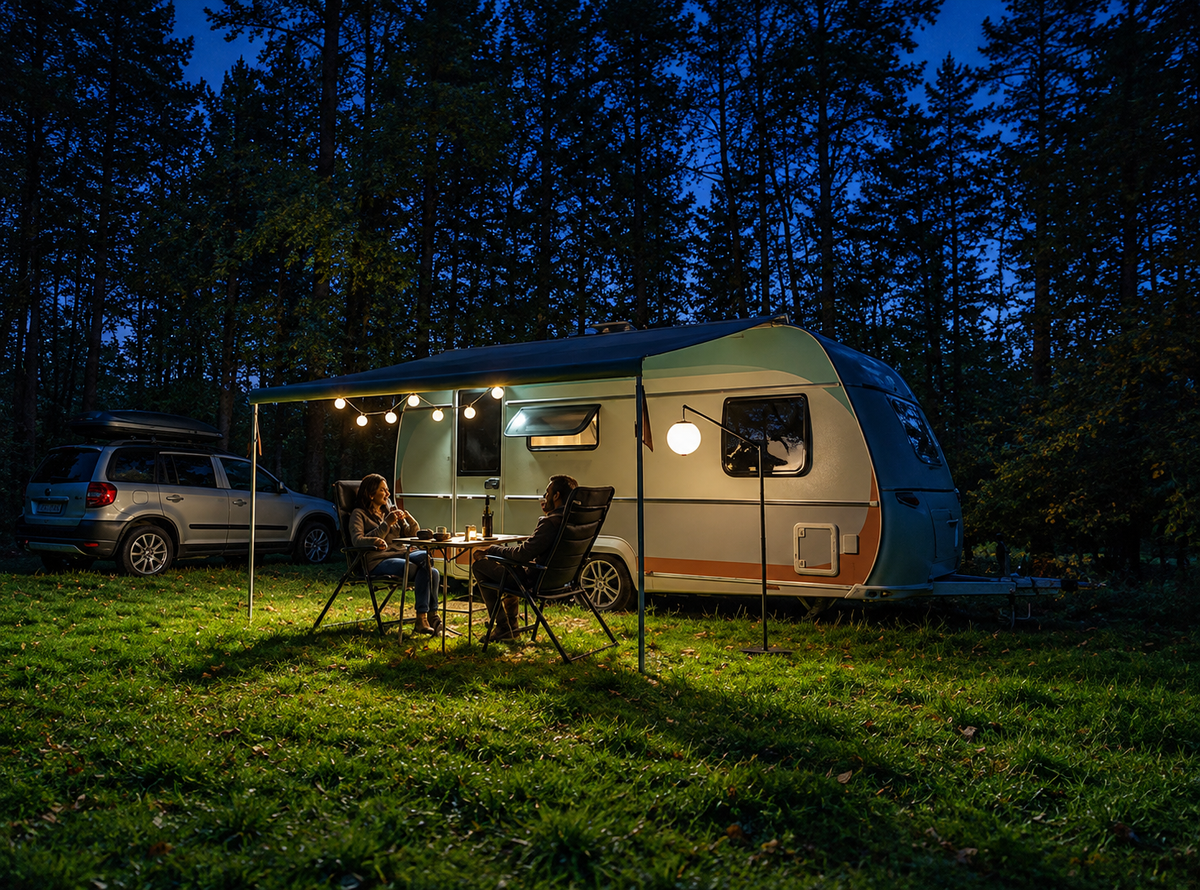
A parking space without shore power does not have to do without lights, a cool box and charged mobile devices. The safest way to start with a power station is to supply individual appliances directly via its 12 V, USB or 230 V outputs. If, on the other hand, the entire caravan electrical system is to be powered via the CEE external inlet, the power station, adapter, electrical protection arrangements and vehicle installation must explicitly fit together.
An improvised feed via an indoor socket or a cable with two plugs is not a solution. It can put exposed contacts at live voltage and bypass protective devices. Before you connect a power station to the caravan, planning begins with the daily requirements and the intended type of connection.
How much electricity does a power station on the caravan need per day?
The daily requirement results from the energy of all consumers, not from their highest wattage. For each device, performance and runtime are multiplied; Conversion losses and a reserve are then added.
Record all consumers and transit times
A reliable list distinguishes continuous consumers from devices that only run for a short time. For a compressor cooler, a measured average value is more helpful than the maximum information on the nameplate. Coffee machines and kettles, on the other hand, require a lot of power, but usually only take a few minutes.
Do this in this order:
- Record the power consumption of each device in watts.
- Realistically estimate the daily runtime in hours.
- Calculate watts times hours and add all the watt hours.
- Allow for about 15 percent conversion and self-consumption losses.
- Plan additional reserves for cold, aging or a day without recharging.
The following example calculation is not a consumption promise, but shows the method:
| Example consumer | Calculation value | energy per day |
|---|---|---|
| Cool box, medium shot | 35W x 12H | 420 Wh |
| LED lighting | 8W x 5H | 40 Wh |
| routers | 10W x 8H | 80 Wh |
| Laptop | 60W x 2H | 120 Wh |
| Two smartphone charges | 15 reps x 2 | 30 Wh |
| Total | 690 Wh |
Assuming 85 percent usable energy, 690 Wh consumption becomes around 812 Wh required nominal capacity. With 20 percent planning reserve, the target size is already close to 975 Wh.
If you want to plan consumption more precisely, you can record the cool box and router for a typical day using an energy meter. Short-term consumers are calculated separately from power and minutes. The measured daily value replaces general manufacturer information and shows whether regular recharging is necessary.
Calculate basic requirements and comfort consumption separately
Basic needs include cooling, necessary lighting, communications and, if necessary, a water pump. Convenience consumers such as coffee machines, hairdryers or hotplates are calculated separately. This way you can see whether the trip already works with the basic requirements and which level of comfort requires the next higher power class.
What power and capacity does the power station have to have?
Performance and capacity answer two different questions. Watt decides whether devices can start and run at the same time. Watt hours determine how long the stored energy lasts.
Determine watts for continuous and starting power
Add up all consumers that are actually running at the same time. The total must remain below the continuous output of the power station. When starting, compressors, pumps and power tools can briefly demand significantly more than during normal operation; The permissible peak power is relevant for this.
A shutdown when starting does not automatically mean a defect. Often the starting peak exceeds the protection limit, a cable causes a voltage drop, or a power saving mode does not correctly detect the load.
Calculate watt hours for travel duration and reserve
How long does a power station last? Approximately: usable energy in watt hours divided by the average load in watts. With a planning assumption of 85 percent, a 1,024 Wh power station delivers around 870 Wh of usable energy. At a constant 100 W, that's roughly 8.7 hours. Temperature, output type, internal consumption and changing loads change the result. The ADAC Powerstation test also points out that the usable net capacity may be lower than the gross figure.
Which devices can be operated simultaneously while on the move?
The decisive factor is the sum of devices active at the same time. The number of sockets alone says nothing about whether the cool box, laptop and cooking device can be operated together.
Combine cool box, light, router and laptop
Moderate consumers can often be grouped together sensibly. A calculation example of a 60 W cool box, 10 W light, 12 W router and 65 W laptop results in 147 W. Nevertheless, the connection limits and the starting power of the cool box must be checked.

Check the coffee machine, kettle and tools separately
Heating devices put a lot of strain on the power station, and tools also put a lot of strain on the power station due to start-up peaks. Switch on high loads at different times and always compare the input power of the device with the continuous and peak power of the station.
| Usage situation | Example total load | Practical classification |
|---|---|---|
| Cool box, light, router, laptop | around 150 W | moderate continuous load |
| Base load plus 1,000W coffee machine | around 1,150 W | stronger model required |
| Base load plus 1,800W kettle | around 1,950 W | Operate individually and check the performance limit |
When does 12 V and when 230 V make sense?
If a device offers both options, the direct 12V supply is usually more efficient. 230 V makes sense if there is only a household plug available or the device requires alternating voltage. The electrical protection arrangements also counts for the caravan installation.
Direct 12V supply and conversion losses
With 12 V there is no need to convert battery direct current to 230 V alternating current. The ADAC explains why Inverter itself requires energy. The voltage, current, plug and polarity must still match. The cable cross-section and the fuse must also match the current because comparatively high currents can flow at low voltage. Never feed into the existing 12 V on-board system without checking.
If you want to connect a power station to a motorhome and use an adapter, you should differentiate between three ways:
- Operate individual devices directly on the power station.
- Supply an approved 12 V consumer at the appropriate output.
- Only use the CEE external inlet with a solution approved by the power station and vehicle manufacturer and have the protective function checked by a specialist.
Before supplying the entire caravan electrical system, you should also clarify how protective conductors, residual current protection and grounding work in this combination. A suitable plug shape does not answer this question. If there is no explicit manufacturer approval or protective measures remain unclear, use the individual outputs of the power station instead.
230 V devices, pure sine and starting current
Sensitive electronics and motor consumers may require a pure sine wave output and sufficient starting reserve. A power station already contains an inverter. Connecting a power station to another inverter is therefore usually neither necessary nor sensible. Never connect the output of the power station to the output of another inverter.
Particularly important: The Schuko outputs of a power station must not be fed back into a caravan or house socket using a self-made cable. If you want to connect emergency power to a house, you need a feed-in and switching device with secure mains isolation. The DKE describes special requirements for this mobile emergency power feeds. Planning and installation belong in the hands of a qualified electrician.
How can the power station be recharged on the go?
Solar modules, mains power and vehicle connection complement each other. The itinerary determines which charging route is available; the technical input limits decide which of these is permissible.
Select solar panel according to input data
When connecting a solar module to the power station, compare the open circuit voltage, operating voltage, current, power rating, plug and polarity with the exact solar input. When connected in series, voltages add up; when connected in parallel, currents add up. Also take into account that the open circuit voltage can increase at low temperatures. Use only one in the current one NITIGO User Manual shared configuration.
Plan AC and vehicle charging safely
AC charging can be planned on the campsite, but must not overwhelm the secured connection together with other high loads. Only the approved charging cable is used in the vehicle at the appropriate connection. Secure the power station against slipping, keep ventilation openings clear and avoid discharging the starter battery when the engine is switched off. Only combine vehicle and solar charging if the manual explicitly allows this mode of operation.
Which NITIGO model suits the travel scenario?
The appropriate model follows from the calculated daily energy, maximum simultaneous load and transport route. Our three power classes differ significantly in terms of capacity, output power and weight.

| model | Capacity | Continuous performance | Weight | Typical classification |
|---|---|---|---|---|
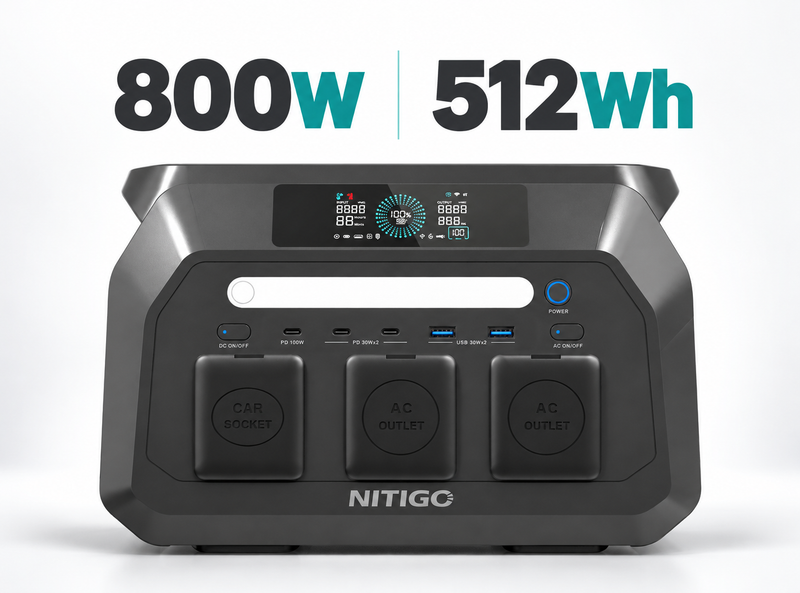
| P800 | 512 Wh | 800W | 6.55kg | short trip, moderate loads |
| P1800 | 1,024 Wh | 1,800W | 12.7kg | higher daily requirement, more reserve |
| P2400 | 2,048 Wh | 2,400W | 24kg | several days or high loads |
P800 or P1800 for short and light trips
Our P800 fits moderate loads when weight and ease of transportation are important. At 512 Wh, the daily requirement should be well below this nominal capacity or should be recharged regularly. With 1,024 Wh and 1,800 W, our P1800 offers more scope for cool boxes, mobile working and individual, more powerful consumers. The specific selection remains a calculation decision, not a blanket recommendation.
P2400 for multiple days and higher loads
Our P2400 combines 2,048 Wh with 2,400 W continuous power. It offers more reserve for longer stays and high individual appliances, but weighs 24 kg. Wheels and pull handle help on firm surfaces; The weight still needs to be taken into account for steps and loading.
Now compare P800, P1800 and P2400 based on your device list, travel time, transport routes and recharging options. The NITIGO Powerstation Overview bundles the models currently offered.
Frequently asked questions
Does a power station have to be grounded when connecting to a caravan?
This depends on the design of the power station, the type of network and the intended connection type. A Schuko or CEE connection alone does not automatically create an effective grounding. If the entire caravan installation is to be supplied, the protective conductor, residual current protection and manufacturer approvals must match. If in doubt, have such a solution checked by a qualified electrician.
Does the FI switch in the caravan work with every power station?
Not automatically. Many power stations create an output system that is separate from the public network. Whether the existing FI switch triggers reliably under these conditions depends on the internal circuitry and the electrical protection arrangements. Therefore, only use the CEE input if the power station and vehicle manufacturers expressly allow this use and the protective function has been professionally tested.
Can the caravan fridge run directly via the power station?
This is possible if the voltage, connection, continuous power and starting power match completely. For a 12 V refrigerator, the output current, plug and polarity must also be checked. Inverter losses occur in 230 V operation. Absorption refrigerators can also have a high continuous consumption, so gas or another approved operating mode is often more practical when traveling.
Can a power station be operated in the awning?
Only if the location is dry, well ventilated and protected from direct sun, rain and heat accumulation. Ventilation openings must remain free and cables must not create a tripping hazard. A completely closed or very heated awning is unsuitable. Please also note the operating and storage temperatures in the manual for the specific power station.
How do you safely switch between shore power and a power station?
Shore power and power station must not be fed into the same caravan installation at the same time in an uncontrolled manner. Only use an approved switching or feed-in solution that safely separates both sources. For a manual solution, first unplug the previous power source before connecting the other one. Self-built feedback cables are unsuitable for this.