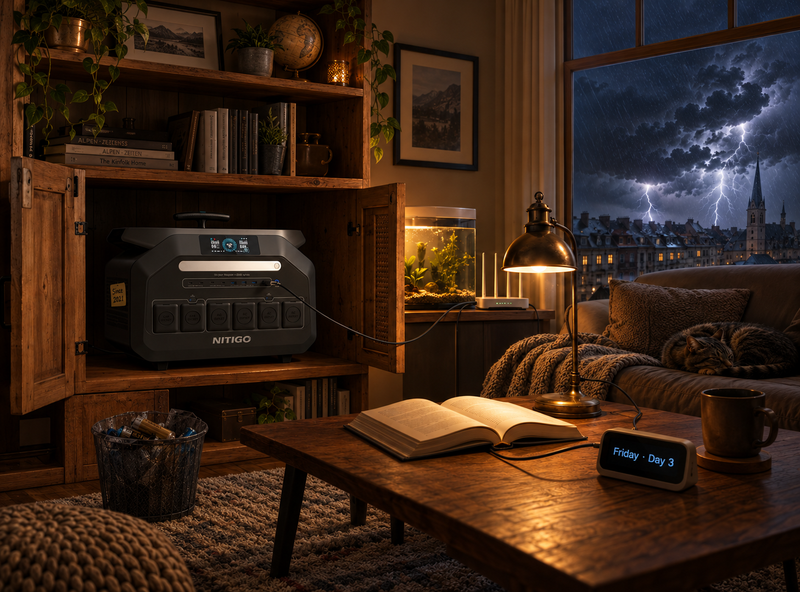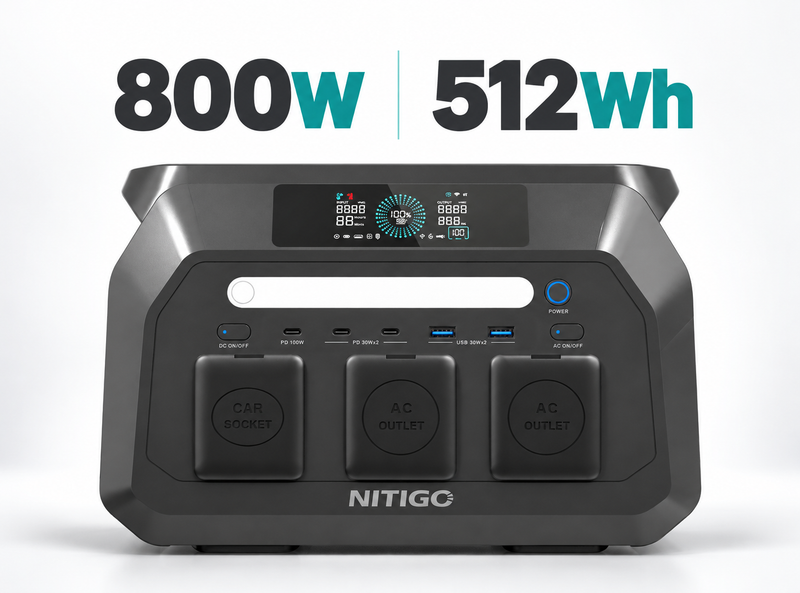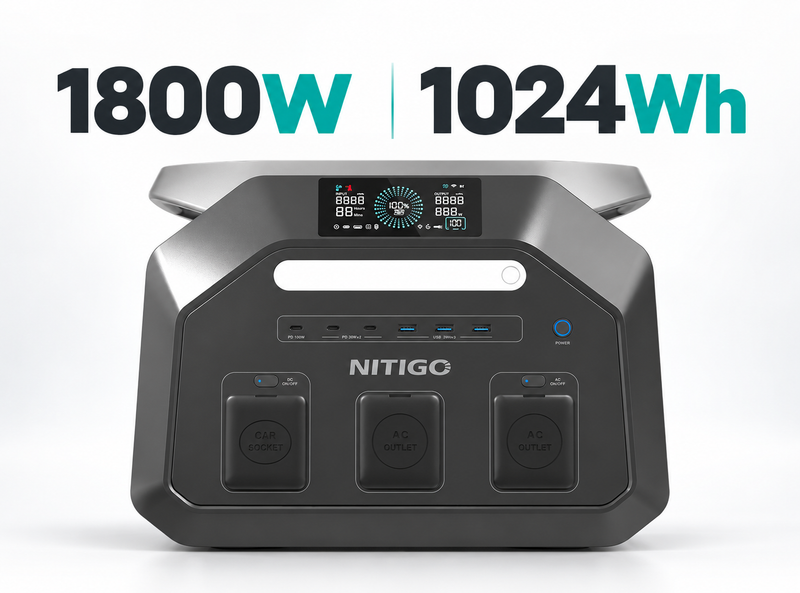




A weekend in a motorhome, a working day without a socket or a temporary power outage place very different demands on the same energy storage device. A power station with 2,048 Wh offers a large energy reserve, but is particularly suitable when if the connected devices match the output power and the weight of around 24 kg remains transportable.
The capacity information alone does not answer how long a refrigerator will run or whether a coffee machine will start. Conversion losses, internal consumption, fluctuating loads and the brief starting surges of motor-driven appliances change the result. A 2,048 Wh power station is therefore more of a mobile energy center for a vehicle, household or permanent workplace than a battery that is often carried by hand. The selection begins with the application profile and a realistic device list.
Who is a 2,048 Wh power station suitable for?
A 2,048 Wh power station is suitable for users who want to power several moderate consumers for many hours or for individual powerful devices for a limited time. It is particularly suitable for longer camping stays, mobile working with multiple devices and a limited power reserve at home. For day trips with a smartphone and light, this capacity would usually be unnecessarily large and heavy.

Differentiate between household, camping and mobile working
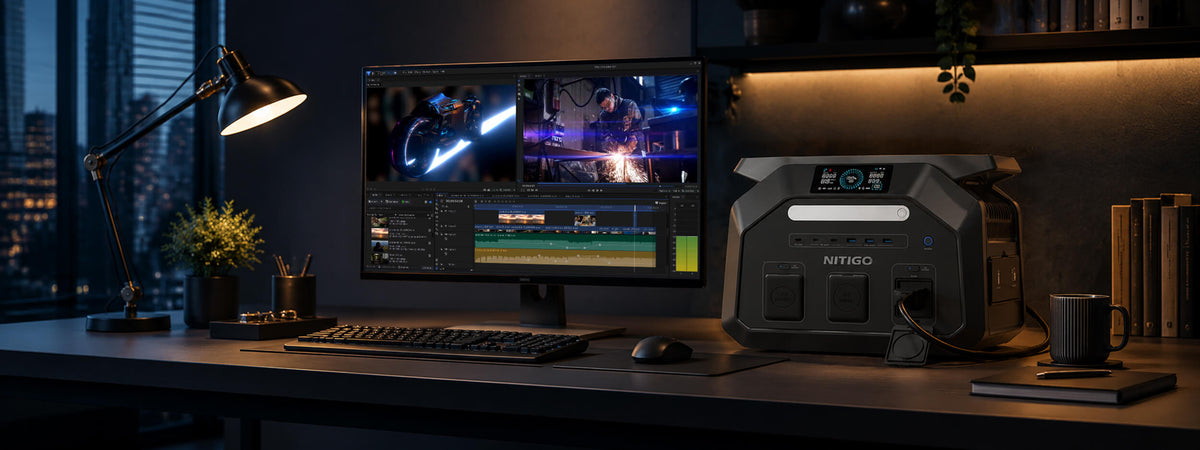
The same memory can appear to have completely different dimensions depending on its use. In the home, the focus is often on cooling, routers and lighting. A 2,048 Wh power station for camping, on the other hand, also has to cope with a cool box, water pump or cooking device. When working mobile, a laptop, monitor, router and charger count, usually with a comparatively even load.
The following overview separates these profiles according to the crucial bottleneck:
| Mission profile | Typical consumers | Most important check point |
|---|---|---|
| Limited time reserve at home | Fridge, router, light | Average consumption and starting power |
| Camping or RV | Cool box, pump, laptop, kitchen appliance | Daily requirements, transport and reloading |
| Mobile working | Laptop, monitor, router, chargers | Runtime at even load |
| Garden or workshop | Tools, charger, pump | Continuous power and starting peak |
A power station does not replace a permanently installed home supply. Devices are operated at the designated outputs. A feed into a building installation requires a suitable switching and protection solution by a qualified electrician.

Set device list and desired runtime
Reliable planning not only records the wattage, but also the daily usage time. Refrigerators run at intervals, while kettles or coffee machines only require energy for a few minutes. An electricity meter often provides better values for refrigerators, routers or workplace technology than a rough assumption. The consumer advice center also recommends measuring if the actual device consumption is unclear.
When taking inventory, proceed in this order:
- Write down all devices with continuous power and possible starting power.
- Note which consumers are running at the same time.
- Record or estimate daily usage time.
- Separate essential devices from convenience consumers.
- Decide when and how the power station can be recharged.
For example, a camping day with 500 Wh for cooling, 120 Wh for the laptop and 80 Wh for light and communication results in 700 Wh. Two days require 1,400 Wh at the output. If 85 percent usable energy and an additional 15 percent planning reserve are set, The required nominal capacity is calculated at around 1,895 Wh. A 2,048 Wh class offers a comprehensible buffer for this example.
How much power is really needed?
The required power does not correspond to the battery capacity. Watt determines which devices can operate at the same time; Watt hours describe the energy stored. A large capacity therefore does not help if the current load already exceeds the permissible output power.
Continuous performance of all devices used at the same time
Only add devices that are actually turned on at the same time. Refrigerator, router, light and laptop can together form a moderate base load. If a heater is also running, the total increases very quickly. The number of sockets does not change the maximum total power.
These examples show the impact of simultaneous use:
| Concurrent consumers | Calculation example | Classification |
|---|---|---|
| Fridge, router, light, laptop | 120 + 12 + 10 + 65W = 207W | moderate continuous load |
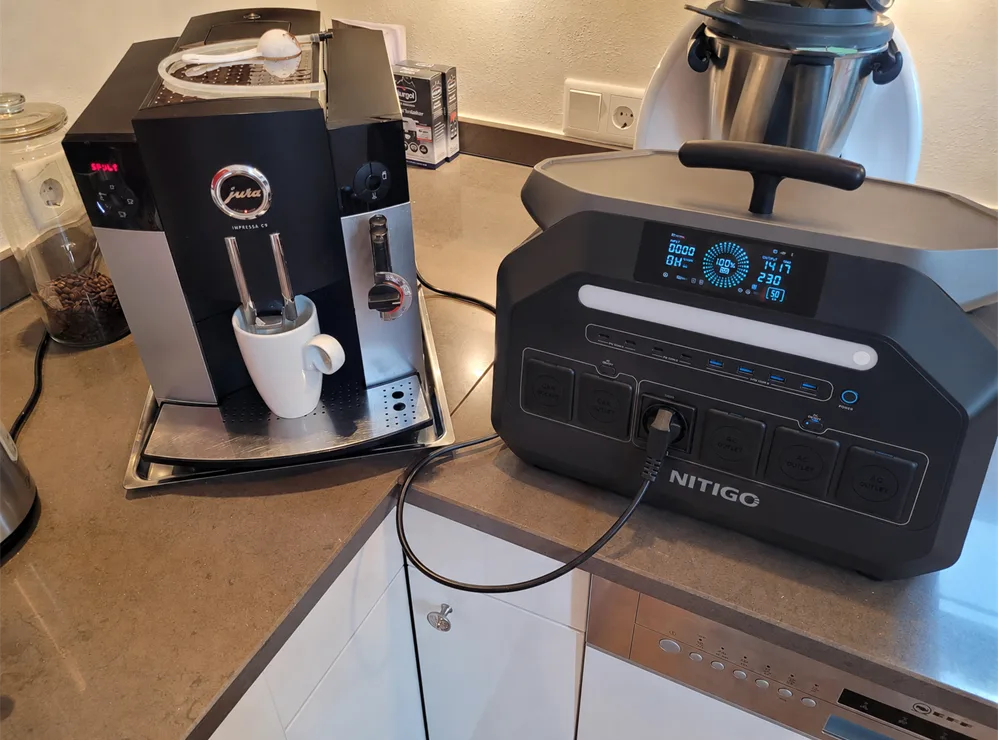
| Base load plus coffee machine | 207 + 1,200W = 1,407W | high load for a short time |
| Base load plus kettle | 207 + 2,000W = 2,207W | Check the performance limit exactly |
| Kettle and coffee machine together | 3,200W or more | often separate in time |
If you are looking for a power station in the 2,000 Wh class for certain devices, you should first compare their combined wattage. The capacity calculation then shows approximately how long this combination can be supplied.
Start-up and peak performance with reserve
Compressors, pumps and some tools briefly require more power when switched on than during normal operation. This starting value must remain below the permissible peak power of the power station. A small reserve prevents another consumer or an unexpected load fluctuation from causing a protective shutdown.
The nameplate does not always give a starting value. Information can often be found in the device manual; If there is uncertainty, a measurement with a suitable measuring device can help. If the power station switches off when starting, other loads should first be disconnected, the cable and output checked and the error display read. Repeated switching on without checking the cause does not solve the problem.
Which capacity fits the planned term?
The appropriate capacity results from consumption, useful life and a realistic loss assumption. For initial planning, 2,048 Wh Expect around 85 percent usable energy. This equates to approximately 1,740 Wh, but is not a guaranteed measurement for every device or output.
Calculate watt hours from consumption and usage time
The basic formula is: Runtime in hours = usable watt hours divided by average power in watts. Conversely, power multiplied by usage time equals the energy requirement. For devices with varying loads, the measured average should be used, not just the highest instantaneous value.
The table uses 1,740 Wh as a transparent planning assumption:
| Average load | Computational runtime | Practical significance |
|---|---|---|
| 50W | around 34.8 hours | Router, light or economical workplace |
| 80W | around 21.8 hours | Example of a measured cooling device average load |
| 200W | around 8.7 hours | several moderate consumers |
| 1,000W | around 1.7 hours | cumulative operating time of a powerful device |
| 2,000W | around 0.9 hours | high load, rapidly decreasing charge level |
The refrigerator runtime of a 2,048 Wh power station cannot therefore be derived from the compressor's rated output alone. Ambient temperature, settings, load and switching cycles change the average consumption. A measurement over 24 hours is more meaningful for planning.
Plan for conversion losses and safety reserves
The battery does not provide its entire nominal capacity at the 230 V output. Inverters, electronics, displays and radio functions themselves require energy. In ADAC test of mobile power stations The usable net capacity of the devices tested was on average around 10 to 15 percent below the gross figure.
Additionally A reserve of 10 to 20 percent is recommendedif cooling or communication needs to remain reliably available. Cold, high temperatures, battery wear and small continuous loads can further change the real runtime. For two days without recharging, a cheap individual value is not simply doubled. First calculate the daily requirement and then add the loss and planning reserve.
The choice of output also influences the result. A compatible DC device can be operated via a suitable DC output without the 230 V inverter. With very small loads, its own consumption is comparatively significant. However, voltage, current, plug and polarity must completely match; A supposedly suitable socket alone does not prove electrical compatibility.
Which NITIGO model suits your needs?

Our NITIGO P2400 fits this capacity range if a maximum of 2,400 W continuous power and up to 4,800 W short-term peak power are sufficient for your device list. It offers 2,048 Wh, weighs 24 kg and measures 445 × 298 × 371 mm. This makes it more suitable for mobile homes, houses, gardens or workshops than for frequent carrying over longer distances.
| feature | NITIGO P2400 | Importance for selection |
|---|---|---|
| Capacity | 2,048 Wh | determines the calculated energy reserve |
| AC continuous power | 2,400W | Limit of simultaneous continuous load |
| AC peak performance | 4,800W | Reserve for short start-up peaks |
| Weight | 24kg | Plan for wheels and a pull handle, stairs remain complex |
| Dimensions | 445 × 298 × 371mm | Check the floor space and storage space in advance |
The weight of a power station with 2,048 Wh is one of the real application limits. Rollers make transport easier on solid surfaces, but do not replace a second person when lifting safely. Before making a selection, you should also compare output types and charging methods with your devices and travel route. Current details can be found on the website NITIGO P2400 and in the appropriate one NITIGO User Manual.
What should you check before purchasing?
Before purchasing, capacity, performance, transport and service must all fit the application. A power station with enough watts but too little energy disappoints in terms of runtime; A large memory with unsuitable outputs also does not solve the connection problem.
This checklist summarizes the crucial points:
- actual daily consumption and desired autonomy
- Total of all devices running at the same time
- Starting performance of refrigerator, pump or tool
- matching 230 V, USB and DC outputs
- available charging methods and time until the next recharging
- Weight, dimensions, footprint and safe transport options
- Operating and storage temperature according to the manual
- Warranty conditions, registration, proof of purchase and available support
Compare these points to your list of devices instead of just choosing the largest capacity. If 2,048 Wh and 2,400 W cover the calculated requirements with reserve and 24 kg fit the transport route, the P2400 is a logical option. Ours Powerstation overview helps when comparing with other power classes.
Frequently asked questions
Can a power station with 2,048 Wh be taken on a plane?
A power station of this capacity class is normally not suitable for carrying in passenger luggage. Airlines typically limit lithium batteries to much smaller watt-hour ratings and require prior approval for certain sizes. Before every trip, ask the airline and pay attention to the current dangerous goods regulations. Do not hand the Powerstation in as normal checked baggage on your own initiative.
Can the capacity of a 2,048 Wh power station be expanded?
Only if the specific model supports a designated expansion connection and expressly approved additional batteries. Any external battery may not be connected directly. Check the user manual to see what additional battery, cables, and maximum total capacity are allowed. If there is no corresponding approval, the existing capacity must be supplemented by recharging in a timely manner.
How high is the internal consumption of a large power station?
Self-consumption depends on which outputs, displays, radio modules and inverters are activated. Especially when the 230 V inverter is switched on, small consumers can require a noticeable proportion of the energy. For realistic planning, measure the energy drawn with the intended load and switch off outputs or communication functions that are not required.
Can a 2,048 Wh power station be used as a UPS?
This is only possible if the model explicitly supports a UPS or EPS function. The decisive factors are the switching time, permissible continuous load and the requirements of the connected devices. Sensitive medical or safety-related technology may not be connected solely because of the “UPS” designation. Check the manual, device specification and, if necessary, the device manufacturer's specifications.
Does a 2,048 Wh power station lose runtime in cold weather?
Yes. Low temperatures can reduce temporary usable capacity and charging performance. Store and operate the power station within the temperature limits stated in the manual. Charging at very low temperatures may be restricted or disabled. Plan for additional capacity reserve in winter and bring a cold device into a permissible temperature range before charging.